COMPUTATIONAL NUMBER THEORY · ACCELERATED COLLATZ · FORMAL PROOF
A CERTIFIED x^0.90 COLLATZ PREDECESSOR LOWER BOUND
0.901 → 0.90
stronger exponent · target-dependent positive scale → clean unit-coefficient endpoint
FOR EVERY FIXED t > 0 WITH 3 ∤ t
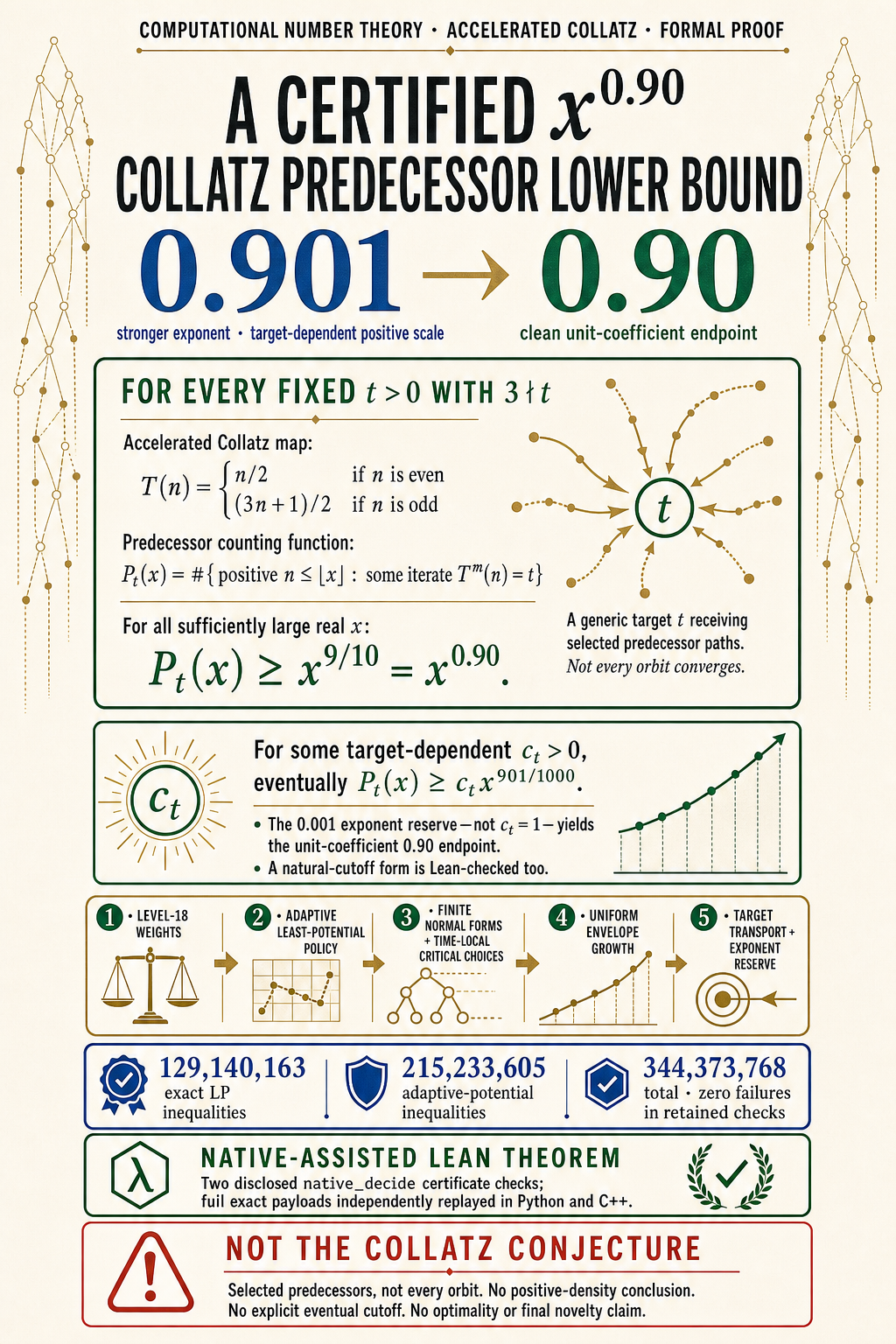
Accelerated Collatz map: T(n) = n/2 if n is even, and (3n + 1)/2 if n is odd.
Predecessor counting function: Pₜ(x) counts positive n ≤ floor(x) such that some iterate T^m(n) = t.
For all sufficiently large real x: Pₜ(x) ≥ x^(9/10) = x^0.90.
A generic target t receives selected predecessor paths; not every orbit converges.
For some target-dependent cₜ > 0, eventually Pₜ(x) ≥ cₜ x^(901/1000).
The 0.001 exponent reserve—not cₜ = 1—yields the unit-coefficient 0.90 endpoint. A natural-cutoff form is Lean-checked too.
FIVE DISPLAYED PROOF STAGES
1 · Level-18 weights
2 · Adaptive least-potential policy
3 · Finite normal forms plus time-local critical choices
4 · Uniform envelope growth
5 · Target transport plus exponent reserve
129,140,163 exact LP inequalities
215,233,605 adaptive-potential inequalities
344,373,768 total · zero failures in retained checks
NATIVE-ASSISTED LEAN THEOREM
Two disclosed native_decide certificate checks; full exact payloads independently replayed in Python and C++.
NOT THE COLLATZ CONJECTURE
Selected predecessors, not every orbit. No positive-density conclusion. No explicit eventual cutoff. No optimality or final novelty claim.