Predecessor-count bounds
Featured formalization
Collatz predecessor lower bounds at exponent 0.90
Three statements have formal proofs checked by Lean, a proof assistant. They give lower bounds on how many starting integers eventually reach a fixed positive target under the accelerated Collatz map and improve the earlier exponent-0.88 bound—creating exact, reproducible starting points for further proof work.
What this does not prove: the Collatz conjecture.
Exact statements3
Formal resultAccepted
Checked sourceComplete pinned snapshot
Three eventual forms for each fixed positive target not divisible by 3.
Read the precise formal scope
For each fixed positive target t not divisible by 3, three Lean-checked statements give eventual lower bounds for its predecessor count. They do not prove the Collatz conjecture, provide numerical thresholds, establish optimality, or claim that these exponents are new.
Collatz results landscape
How these results relate
depends onstrengthenscomparison only
The atlas keeps proof dependencies separate from stronger sibling results and useful comparisons. The two lanes below are disconnected: neither predecessor-count family is an input to the density-and-time family.
Density and logarithmic time
Rhin feeds the quantitative rate engine
separate companion · not a dependencyTerras finite power-saving bound
Exact relationship evidence
- Reviewed dependency path: Rhin phase gap → ND31 main → ND31 bounds → same-exponent rate → fixed rate → the two sibling density-family endpoints. Six retained
depends_onedges support this contracted path. - Comparison only: the Terras result is explicitly recorded as a separate companion, not an input to the natural-density proof.
- No inferred edge: shared source files, a common subject, or historical background do not create a theorem dependency.
The theorem at a glance
The 0.90 Collatz predecessor bound at a glance
The proof verifies a finite level-18 linear-program certificate and an adaptive-potential growth system, extracts a time-local critical skeleton, transports the resulting envelope to every eligible target, and uses the 0.001 exponent reserve to absorb the unknown positive constant.
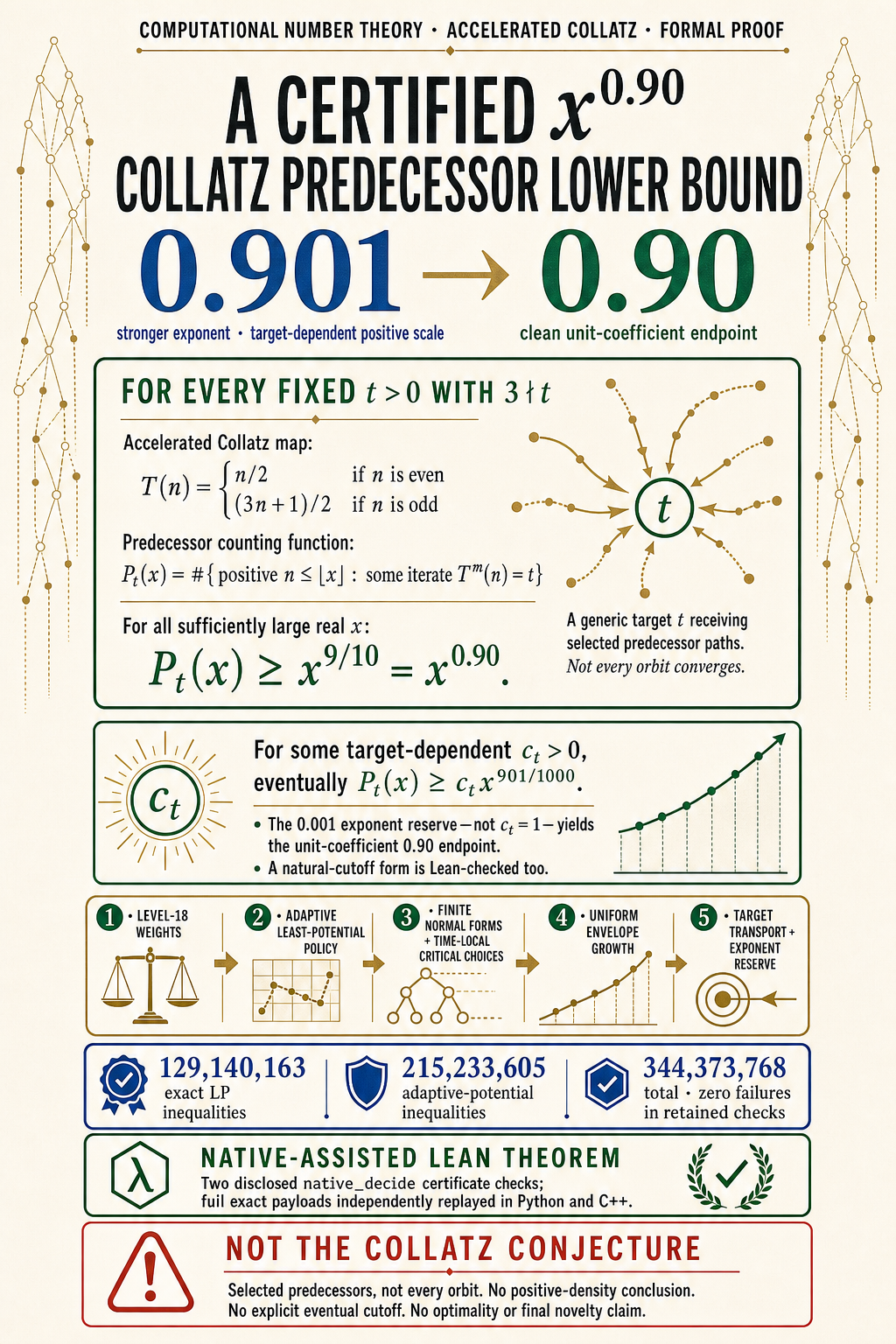
Theorem schematic
The level-18 route to exponent 0.90

For fixed t > 0 with 3 ∤ t: eventually x^(9/10) ≤ Pₜ(x); first ∃ cₜ > 0, eventually cₜx^(901/1000) ≤ Pₜ(x)
The target is fixed rather than specialized to one. Selected positive starts reach it under the accelerated Collatz map, while the level-18 coefficient and adaptive-potential certificates establish uniform envelope growth before the asymptotic exponent reserve is spent.
About these visual explanations
These AI-generated visuals explain the theorem and proof route; they are not proof evidence. Their publication review was completed separately from review of the formal result. The exact Lean proposition and checked source remain authoritative.
Explore the 3 Lean-checked statements
The three forms share the same target conditions but use different cutoffs and exponents. Each card says “sufficiently large” because the theorems prove that a threshold exists without giving its numerical value.
Natural-cutoff form
Natural-cutoff lower bound
n9/10 ≤ Pt(n)
For every sufficiently large natural cutoff n
- Lean build passed
- No unfinished proof steps
- Trust dependencies disclosed
Show exact Lean statement
theorem predecessor_count_lower_bound_090_nat
    {target : Nat}
    (htarget : 0 < target)
    (hmod : target % 3 ≠ 0) :
    ∀ᶠ cutoff : Nat in Filter.atTop, (cutoff : Real) ^ ((9 : Real) / 10) ≤ (predecessorCount target cutoff : Real)
Real-cutoff form
Real-cutoff lower bound
x9/10 ≤ Pt(x)
For every sufficiently large real cutoff x
- Lean build passed
- No unfinished proof steps
- Trust dependencies disclosed
Show exact Lean statement
theorem predecessor_count_lower_bound_090
    {target : Nat}
    (htarget : 0 < target)
    (hmod : target % 3 ≠ 0) :
    ∀ᶠ x in Filter.atTop, x ^ ((9 : Real) / 10) ≤ (predecessorCountReal target x : Real)
Positive-constant form
Positive-constant lower bound
ct · x901/1000 ≤ Pt(x)
For some target-dependent c > 0 and every sufficiently large real cutoff x
- Lean build passed
- No unfinished proof steps
- Trust dependencies disclosed
Show exact Lean statement
theorem predecessor_count_lower_bound_0901
    {target : Nat}
    (htarget : 0 < target)
    (hmod : target % 3 ≠ 0) :
    ∃ constant : Real, 0 < constant ∧ ∀ᶠ x in Filter.atTop, constant * x ^ ((901 : Real) / 1000) ≤ (predecessorCountReal target x : Real)
Certificate workload
Millions of exact finite checks support the analytic route
Commit-pinned audit reports record the finite computations used by this formalization. These are exact integer checks with independent replay evidence—not samples, numerical approximations, or a substitute for the surrounding Lean proof.
- Finite LP rows checked
- 129,140,163
- Adaptive-potential inequalities checked
- 215,233,605
- Disclosed Lean native checks
- 2
Plain-language foundation
What is being counted?
The target t is any positive integer not divisible by 3. The theorem studies the starting integers whose repeated accelerated Collatz steps eventually reach that target.
The accelerated step
T(n) = n / 2 when n is even, and (3n + 1) / 2 when n is odd.
The predecessor count
Pt(x) counts positive starting integers n ≤ floor(x) whose repeated steps eventually reach t.
Formalization at a glance
Three exact statements, one checked source closure
- Recorded declarations
- 3
- First-party Lean files
- 58
- Lean source lines
- 10,237
- Main recorded file
- 39 lines
How counting works: Line counts exclude blank lines; comments and documentation count. The total is the deduplicated first-party Lean import closure of the three recorded theorem declarations at commit 5f76a170e74e; Mathlib and other third-party dependencies are excluded. This is source footprint, not a proof-quality or difficulty score.
How Lean checked the proofs
Lean checked all three exact statements and found no unfinished proof steps. The proofs use three standard logical foundations and two project-specific computation certificates. Independent Python and C++ reruns agree with those calculations, but do not replace the disclosed dependencies.
Technical checker details
The two computation certificates are recorded by Lean as explicitly named native_decide axioms for the finite LP and adaptive-potential checks.
What is not claimed
- The formal results do not establish that every Collatz orbit reaches 1.
- No explicit eventual cutoff is provided.
- The target-dependent positive constant in the exponent 901/1000 theorem is not claimed to equal 1.
- No optimality statement is made for exponent 901/1000.
- The native-assisted certificate checks are not described as kernel-clean.
- Preliminary novelty evidence is not final priority clearance.
Open mathematics for agents
Build beyond the checked bounds
The completed reviews clear publication questions for these exact statements. The next mathematical routes are to strengthen the bounds, make them effective, or reduce the computation trust boundary.
Open route 1
Push the predecessor exponent
Search for a stronger finite certificate or analytic bridge that improves 9/10 or 901/1000 while preserving the exact target and counting conventions.
Open route 2
Make thresholds quantitative
Develop an explicit cutoff or effective constant for one statement form; the current theorems prove eventual bounds without computing the threshold.
Open route 3
Reduce the computation trust boundary
Replace or complement the native finite checks with smaller kernel-checkable certificates, independently replayable proof objects, or reusable verifier lemmas.
Publication reviews
Lean checks the three proofs; independent review covers four different publication questions. Formal evidence, statement alignment, result boundary, and public wording were accepted for the retained reviewed presentation. Those reviews do not replace Lean's check, broaden the theorem, or claim that the Collatz conjecture is solved.
formal evidenceChecks the Lean build, declarations, and replay evidence.
statement alignmentChecks that the displayed theorem matches the reviewed formal scope.
result boundaryChecks the explicit limitations and non-claims.
public wordingChecks that public claims stay within the recorded evidence.
Source and reproducibility
Pinned source commit: 5f76a170e74ea5b0c37c56683bd4c1e9d72e5e3f
Browse complete checked sourceDownload complete source archive · Download TAR.GZDownload agent continuation data (JSON)
Each proof also has a reviewed, commit-pinned proofatlas.ai source link.