NUMBER THEORY · NATURAL DENSITY · COLLATZ DYNAMICS
COLLATZ DESCENT IN LOGARITHMIC TIME
TWO CLOCKS · TWO PRECISE DENSITY DOMAINS
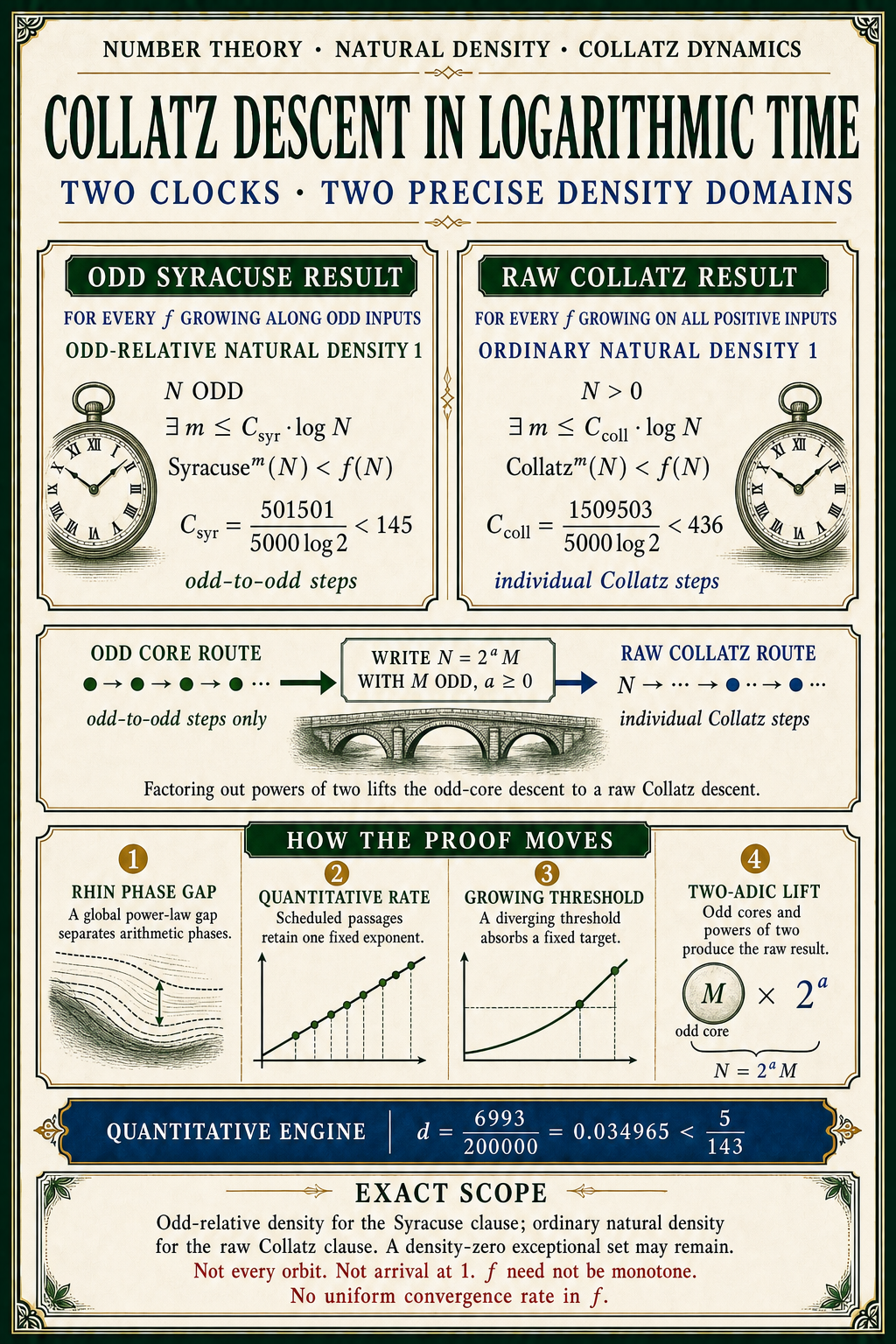
ODD SYRACUSE RESULT
FOR EVERY f GROWING ALONG ODD INPUTS
ODD-RELATIVE NATURAL DENSITY 1
N ODD
∃ m ≤ C_syr · log N
Syracuse^m(N) < f(N)
C_syr = 501501/(5000 log 2) < 145
odd-to-odd steps
RAW COLLATZ RESULT
FOR EVERY f GROWING ON ALL POSITIVE INPUTS
ORDINARY NATURAL DENSITY 1
N > 0
∃ m ≤ C_coll · log N
Collatz^m(N) < f(N)
C_coll = 1509503/(5000 log 2) < 436
individual Collatz steps
ODD CORE ROUTE
WRITE N = 2^a M WITH M ODD, a ≥ 0
RAW COLLATZ ROUTE
Factoring out powers of two lifts the odd-core descent to a raw Collatz descent.
HOW THE PROOF MOVES
1 · RHIN PHASE GAP
A global power-law gap separates arithmetic phases.
2 · QUANTITATIVE RATE
Scheduled passages retain one fixed exponent.
3 · GROWING THRESHOLD
A diverging threshold absorbs a fixed target.
4 · TWO-ADIC LIFT
Odd cores and powers of two produce the raw result.
d = 6993/200000 = 0.034965 < 5/143
EXACT SCOPE
Odd-relative density for the Syracuse clause; ordinary natural density for the raw Collatz clause. A density-zero exceptional set may remain. Not every orbit. Not arrival at 1. f need not be monotone. No uniform convergence rate in f.