If there is a one-to-one function from α into β and another one-to-one function from β into α, then there is a function from α to β that is both one-to-one and onto.
Accepted Atlas resultNot recorded for the preferred artifact
These states distinguish upstream identity, local reproduction, review, and Atlas acceptance. This page is part of the public, read-only Mathlib landmark collection.
Formal orientation
Statement map
This deterministic map orients the reader from the mathematical summary to the pinned declaration and exact checked form. The HTML statement below is authoritative.
The theorem at a glance
Schröder–Bernstein Theorem at a glance
A source-bound editorial overview of the exact Mathlib formulation. The image is explanatory; the statement map, formal type, and pinned source remain authoritative.
Schröder–Bernstein Theorem at a glance
Loading full-resolution image…
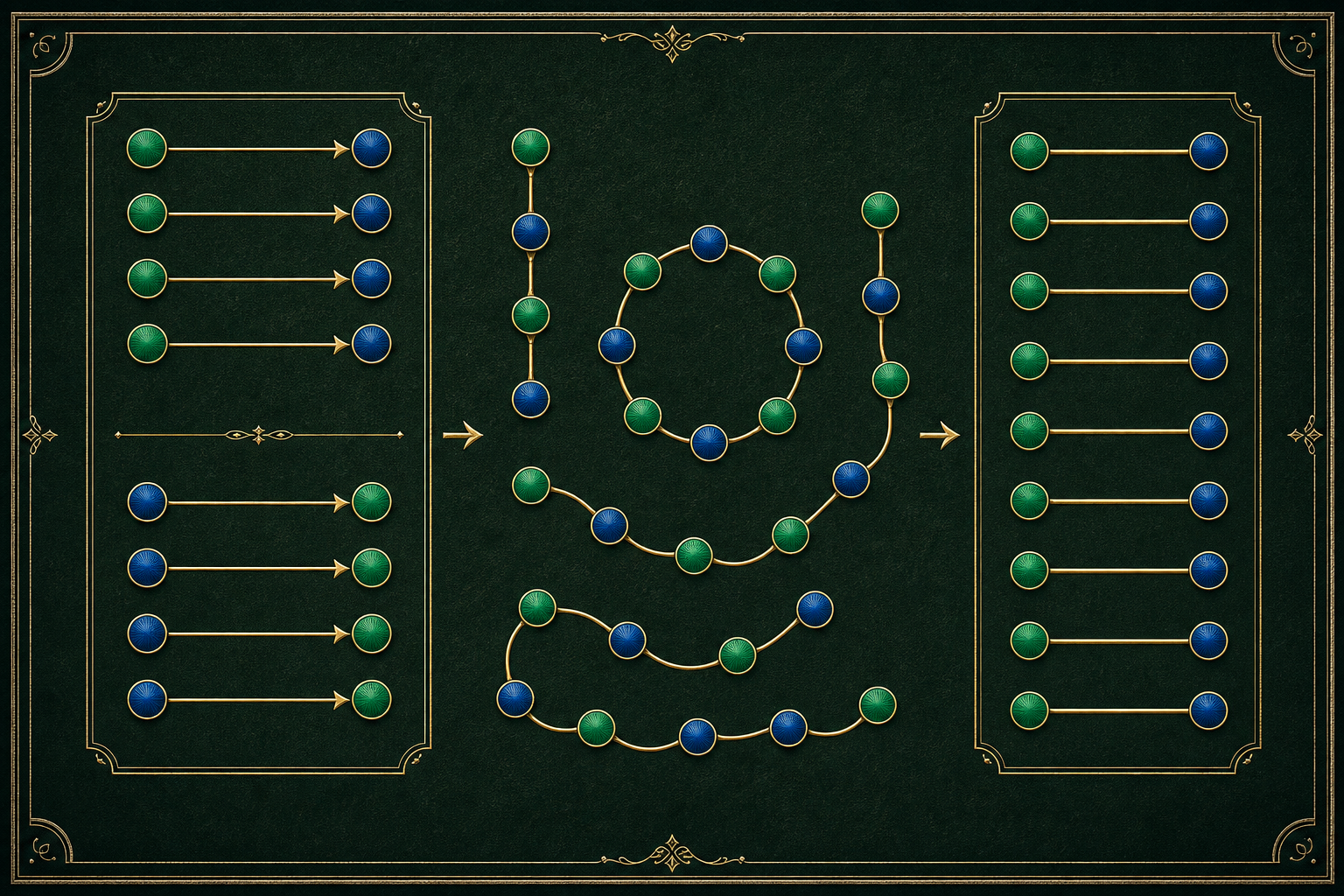
Two particular injections in opposite directions imply the existence of a new bijection; neither input map is presented as bijective.Open original image in a new tab ↗
Two particular injections in opposite directions imply the existence of a new bijection; neither input map is presented as bijective. Generated explanation only; the exact HTML statement and pinned source are authoritative.Detailed visual description
The top half displays separate forward and backward injections with unused target points. Alternating chains appear in a middle proof-intuition strip. The lower half reorganizes the two point fields into one exact pairing h, next to separate injective and surjective cues and an explicit scope footer.
Two injections are decomposed into alternating components and resolved into a bijection. Generated explanation only; the exact HTML statement and pinned source are authoritative.Detailed visual description
Two source-and-target diagrams on the left show total injections in opposite directions. Alternating colored chains and a loop occupy the center. On the right, isolated emerald and cobalt nodes are paired exactly once by clean horizontal segments, with no within-column links.
Complementary intuition
A mathematical landmark
Schröder–Bernstein turns two cardinal inequalities into an equality of cardinality. It is fundamental to comparing infinite sets without first constructing a bijection directly.
The low-text schematic gives the theorem a visual identity; it does not replace the source-bound poster or exact statement.
Authoritative formal type
Exact Mathlib statement
Function.Embedding.schroeder_bernstein {α : Type u} {β : Type v} {f : α → β} {g : β → α} (hf : Function.Injective f) (hg : Function.Injective g) : ∃ h : α → β, Function.Bijective h
Selected evidence declaration text
theorem Function.Embedding.schroeder_bernstein {α : Type u} {β : Type v} {f : α → β} {g : β → α} (hf : Function.Injective f) (hg : Function.Injective g) : ∃ h : α → β, Function.Bijective h
Proof architecture
How two injections produce a new bijection
5 curated stages
Mathlib's selected theorem specializes a stronger relation-preserving construction: choose a least fixed-point region, transport its complement through a partial inverse, define a piecewise map, prove it surjective and injective, and discard the trivial relation witness.
These source-anchored stages explain the retained Mathlib proof route. They are generated explanations, not proof evidence or an extracted Lean proof-term dependency graph.
01
Reduce to the stronger construction
Reduce to the stronger construction
Loading full-resolution image…
The selected theorem delegates to a stronger relation-preserving construction, with the empty case closed first.Open original image in a new tab ↗
The selected theorem delegates to a stronger relation-preserving construction, with the empty case closed first.
schroeder_bernstein calls schroeder_bernstein_of_rel with the constantly true relation. Inside that helper, if β is empty then injectivity of f forces α empty and the empty equivalence supplies the result; the nonempty branch carries the fixed-point construction.
02
Choose the least fixed-point region
Choose the least fixed-point region
Loading full-resolution image…
A monotone complement-image operator selects the least source region on which the forward injection will be used.Open original image in a new tab ↗
A monotone complement-image operator selects the least source region on which the forward injection will be used.
F s = (g '' (f '' s)ᶜ)ᶜ; s = F.lfp
The operator sends a source subset to the complement of g applied to the complement of its f-image. Mathlib takes F.lfp and uses F.map_lfp to identify the chosen region with its image under this operator; complement injectivity yields the corresponding identity for the outside region.
03
Transport the complement through a partial inverse
Transport the complement through a partial inverse
Loading full-resolution image…
The partial inverse of the backward injection sends the outside region onto precisely the target points missed by the forward branch.Open original image in a new tab ↗
The partial inverse of the backward injection sends the outside region onto precisely the target points missed by the forward branch.
g' '' sᶜ = (f '' s)ᶜ
leftInverse_invFun turns g' into a left inverse of g. Combining that fact with the fixed-point complement identity proves g' '' sᶜ = (f '' s)ᶜ, which is the exact coverage relation needed by the piecewise map.
04
Define the piecewise map and cover the target
Define the piecewise map and cover the target
Loading full-resolution image…
The new map uses f on the least fixed-point region and the partial inverse of g outside it; the two images cover complementary target regions.Open original image in a new tab ↗
The new map uses f on the least fixed-point region and the partial inverse of g outside it; the two images cover complementary target regions.
h = s.piecewise f g'; Function.Surjective h
Mathlib defines h by Set.piecewise. range_piecewise splits its range into the f-image of s and the g'-image of sᶜ; substituting the complement identity and union_compl_self proves Surjective h.
05
Prove one-to-one and conclude
Prove one-to-one and conclude
Loading full-resolution image…
Branchwise injectivity and complement separation make the new surjective map one-to-one, yielding the required bijection.Open original image in a new tab ↗
Branchwise injectivity and complement separation make the new surjective map one-to-one, yielding the required bijection.
∃ h : α → β, Function.Bijective h
injective_piecewise_iff uses hf on the selected region, the left-inverse law for g' on the complement, and the fact that an outside target cannot lie in f '' s. The helper returns h with both properties, and schroeder_bernstein specializes its relation to True and keeps the bijectivity witness.
Claim boundary
No new theorem is claimed
The selected declaration concludes that a bijective function α → β exists from hypotheses that particular functions f and g are injective. It does not assert that either given injection is itself bijective, and the page does not claim a new construction.
Proof Atlas did not originate the Schröder–Bernstein theorem or Mathlib's declaration.
The direct upstream theorem, not a local wrapper, is the canonical mathematical object.
A historical or future review cannot be inferred from the build evidence alone.