Measure theory and analysis · existing Mathlib declaration
Radon–Nikodym Theorem
When μ assigns zero mass wherever ν does, the Radon–Nikodym derivative acts as a nonnegative density that reweights ν to recover all of μ exactly—and the reconstruction equality also implies that absolute continuity.
- absolute continuity of measures
- Radon–Nikodym derivative
- measure density
- Lebesgue decomposition
- ENNReal-valued functions
The theorem at a glance
Radon–Nikodym Theorem at a glance
A source-bound editorial overview of the exact Mathlib formulation. The image is explanatory; the statement map, formal type, and pinned source remain authoritative.
Radon–Nikodym Theorem at a glance
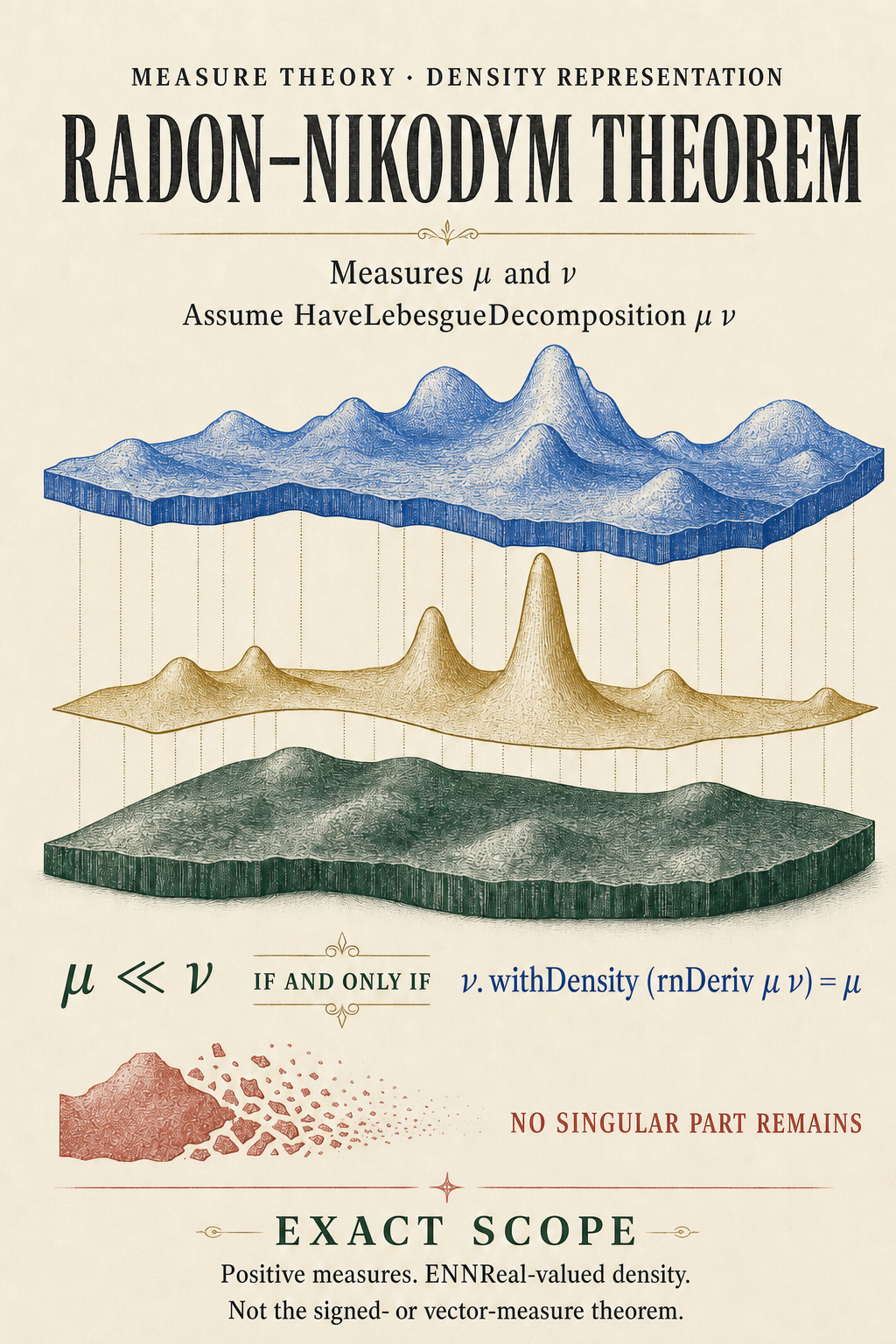
Detailed visual description
The poster presents the assumption HaveLebesgueDecomposition μ ν, then aligns a green ν base, a variable gold density layer, and a blue μ field. The central row states μ ≪ ν if and only if ν.withDensity (rnDeriv μ ν) = μ. A muted red singular fragment dissolves before a footer limits the result to positive measures and excludes signed- and vector-measure claims.
Formal orientation
Statement map
This deterministic map orients the reader from the mathematical summary to the pinned declaration and exact checked form. The HTML statement below is authoritative.
Radon–Nikodym Theorem — scientific diagram
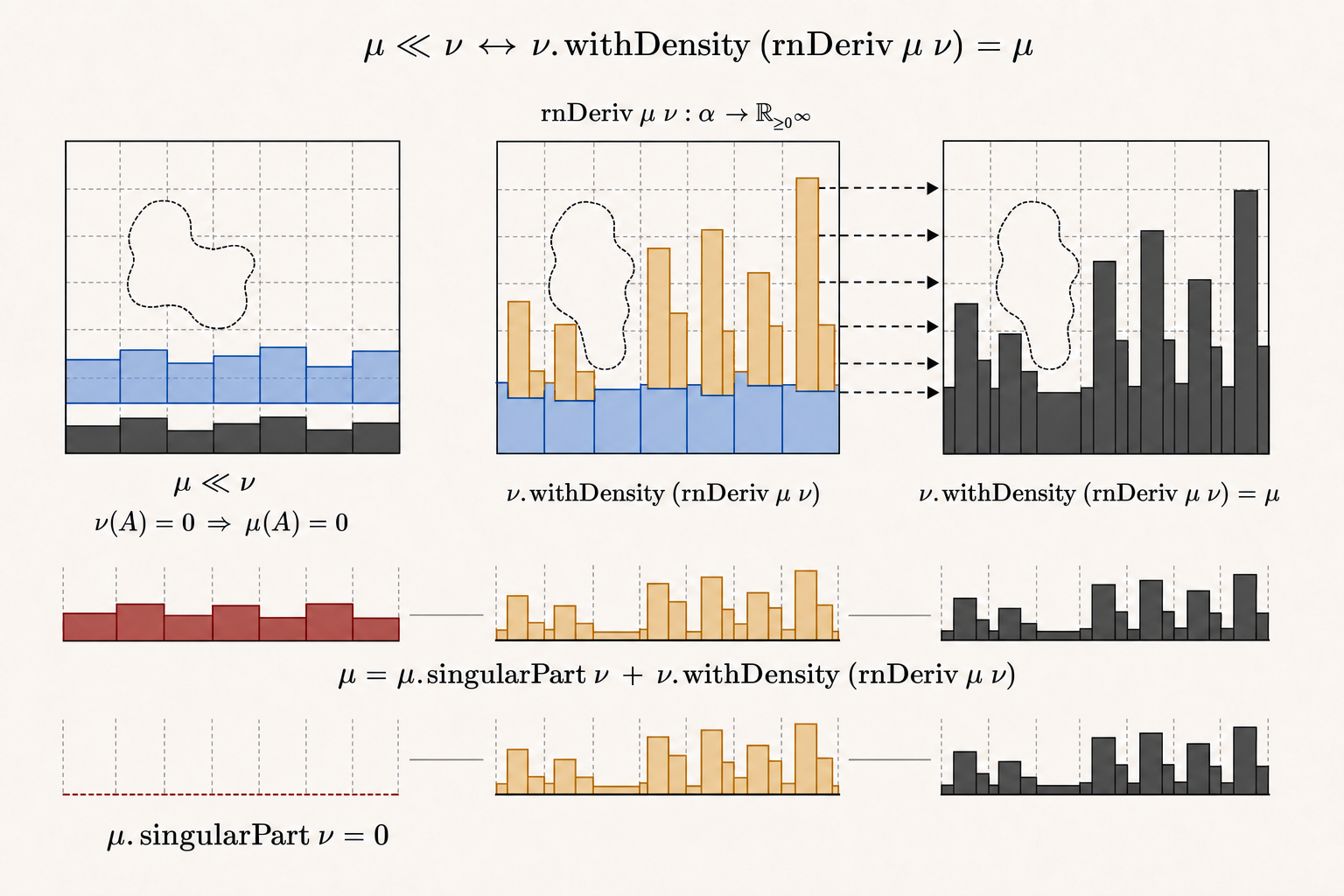
Detailed visual description
This page indexes Mathlib's positive-measure Radon–Nikodym theorem. For measures μ and ν on one measurable space, it assumes HaveLebesgueDecomposition μ ν and states the exact equivalence μ ≪ ν ↔ ν.withDensity (rnDeriv μ ν) = μ. The density is ENNReal-valued. The selected declaration is not the signed-measure theorem, not a vector-measure theorem, and not an assumption-free existence claim for arbitrary measure pairs.
Complementary intuition
A mathematical landmark
The Radon–Nikodym theorem is the central representation principle for absolutely continuous measures. It turns a qualitative relation between null sets into an exact density formula and underlies foundational constructions throughout analysis and probability.
The low-text schematic gives the theorem a visual identity; it does not replace the source-bound poster or exact statement.
Authoritative formal type
Exact Mathlib statement
theorem MeasureTheory.Measure.absolutelyContinuous_iff_withDensity_rnDeriv_eq {α : Type*} {m : MeasurableSpace α} {μ ν : Measure α} [HaveLebesgueDecomposition μ ν] : μ ≪ ν ↔ ν.withDensity (rnDeriv μ ν) = μSelected evidence declaration text
theorem MeasureTheory.Measure.absolutelyContinuous_iff_withDensity_rnDeriv_eq {α : Type*} {m : MeasurableSpace α} {μ ν : Measure α} [HaveLebesgueDecomposition μ ν] : μ ≪ ν ↔ ν.withDensity (rnDeriv μ ν) = μProofAtlas record
What has been checked
These states distinguish upstream identity, local reproduction, review, and Atlas acceptance. This page is part of the public, read-only Mathlib landmark collection.
Claim boundary
No new theorem is claimed
This page indexes Mathlib's positive-measure Radon–Nikodym theorem. For measures μ and ν on one measurable space, it assumes HaveLebesgueDecomposition μ ν and states the exact equivalence μ ≪ ν ↔ ν.withDensity (rnDeriv μ ν) = μ. The density is ENNReal-valued. The selected declaration is not the signed-measure theorem, not a vector-measure theorem, and not an assumption-free existence claim for arbitrary measure pairs.
- Proof Atlas did not originate the Radon–Nikodym theorem or Mathlib's declaration.
- The selected declaration requires HaveLebesgueDecomposition μ ν and concerns positive measures with an ENNReal-valued density, not the signed- or vector-measure variants.
- The generated explanation and visuals are not proof evidence.
Provenance
Origin and evidence stay separate
- Existing declaration
MeasureTheory.Measure.absolutelyContinuous_iff_withDensity_rnDeriv_eqin mathlib- Relationship
- The checked artifact is the upstream declaration itself
- Preferred checked artifact
artifact.library.mathlib.radon-nikodym-theorem.v001- Source handling
- Verified upstream reference; no mirrored source package