Logic and foundations · existing Mathlib declaration
Łoś's Theorem
Build an ultraproduct from a family of nonempty structures and an ultrafilter on their indices. A first-order sentence is true in the resulting ultraproduct exactly when the set of indices whose structures satisfy that sentence belongs to the ultrafilter.
- first-order language
- ultrafilter
- ultraproduct
- sentence satisfaction
- model-theoretic transfer
The theorem at a glance
Łoś's theorem at a glance
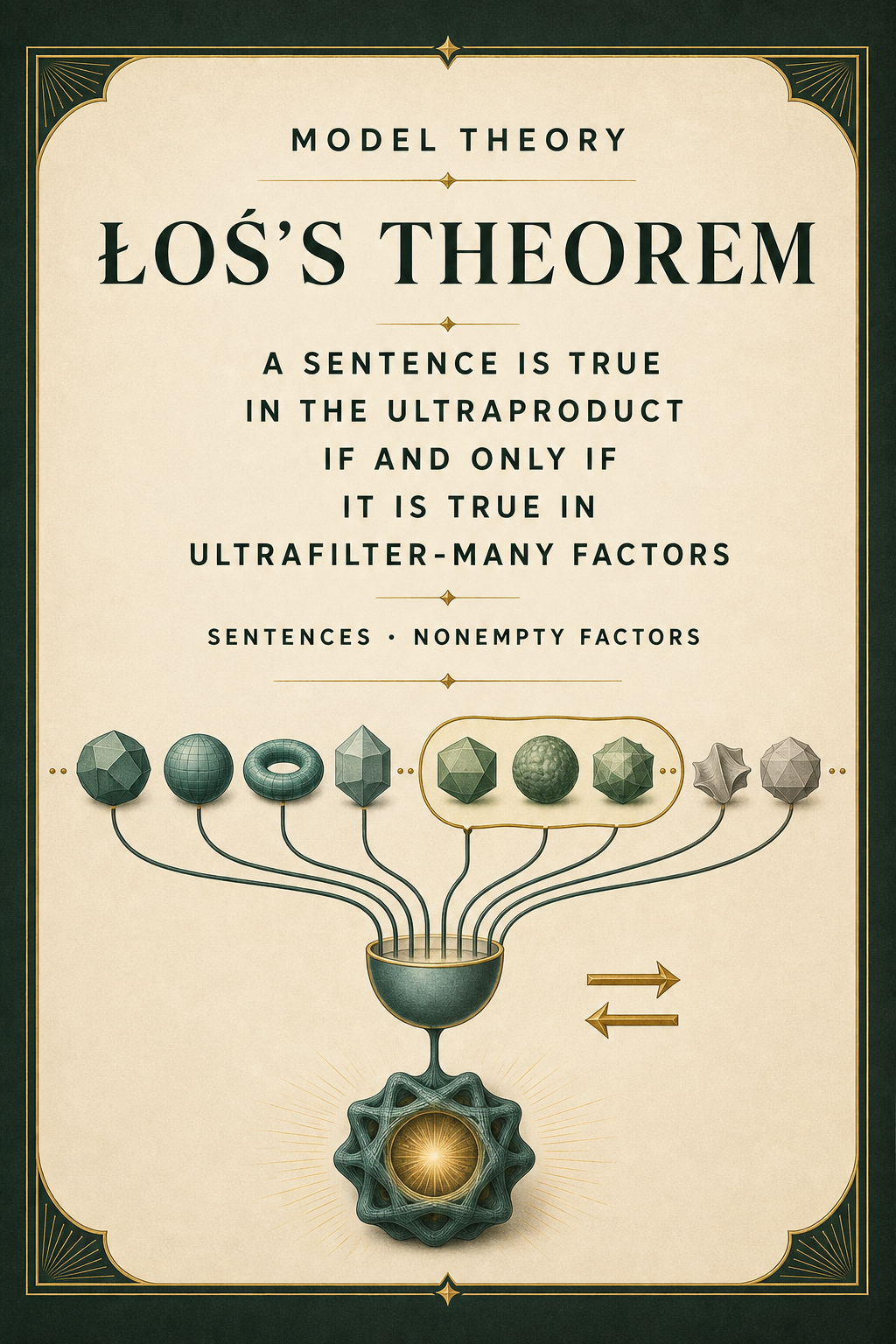
A source-bound editorial overview of the exact Mathlib formulation. The image is explanatory; the statement map, formal type, and pinned source remain authoritative.
Łoś's theorem at a glance
Detailed visual description
The poster keeps the exact sentence-level endpoint prominent. Every displayed factor feeds the construction, a gold contour distinguishes an ultrafilter-large satisfying region without implying a vote, and a balanced two-way mark communicates the if-and-only-if truth transfer.
Formal orientation
Statement map
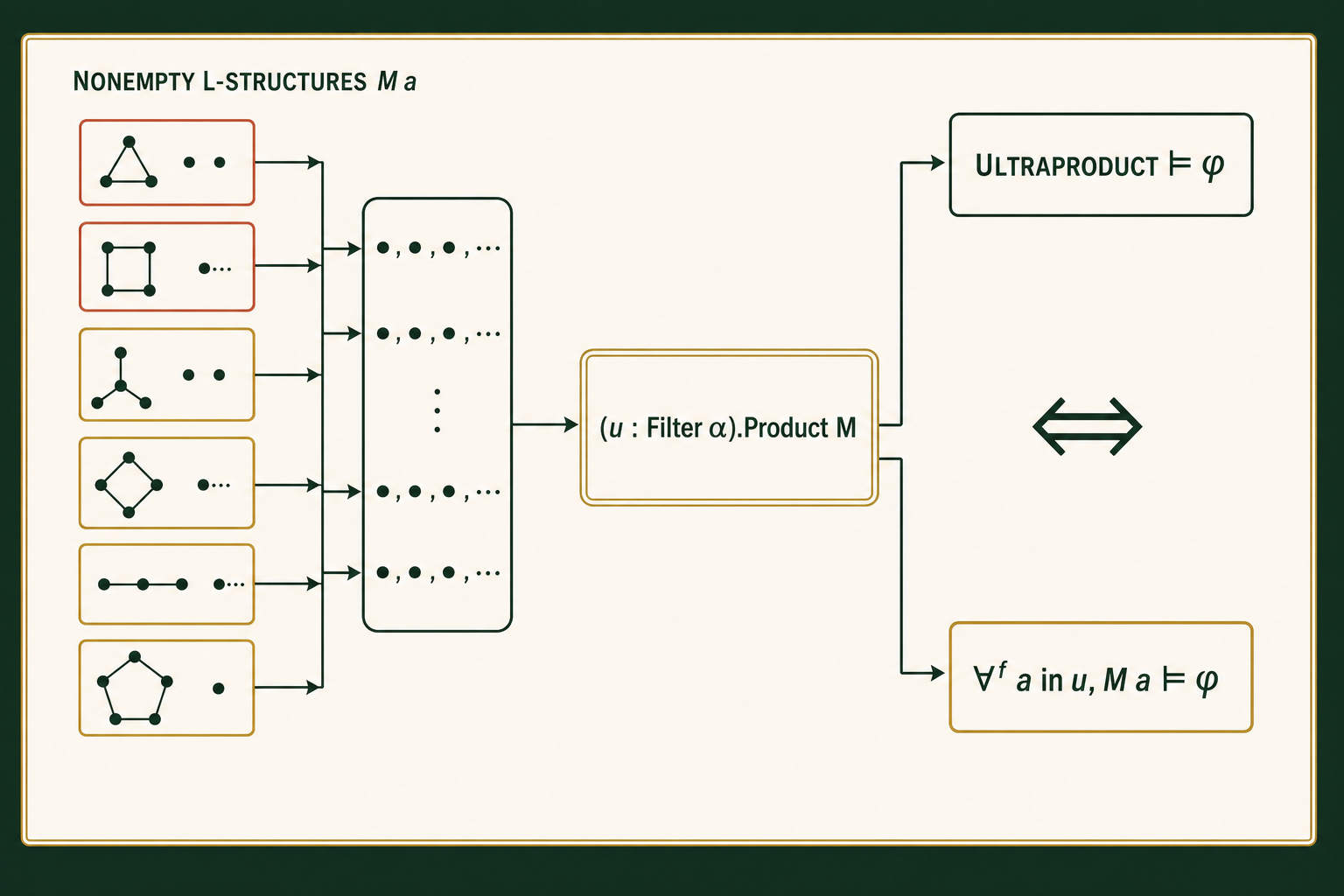
This deterministic map orients the reader from the mathematical summary to the pinned declaration and exact checked form. The HTML statement below is authoritative.
Łoś's Theorem — scientific diagram
Detailed visual description
This target indexes Mathlib's sentence-level form of Łoś's theorem. For an ultrafilter u and a family M of nonempty L-structures, the ultraproduct satisfies a sentence φ exactly when M a satisfies φ for u-almost every a. “u-almost every” means membership in the ultrafilter; it is not numerical majority, probability, or measure. The selected endpoint does not itself display parameters for formulas with free variables.
Complementary intuition
A mathematical landmark
Łoś's theorem is the central transfer principle for ultraproducts: first-order truth in the quotient structure is governed exactly by ultrafilter-large truth among the factors. It is foundational to compactness arguments, nonstandard models, and modern model theory.
The low-text schematic gives the theorem a visual identity; it does not replace the source-bound poster or exact statement.
Authoritative formal type
Exact Mathlib statement
theorem FirstOrder.Language.Ultraproduct.sentence_realize {α : Type*} {M : α → Type*} {u : Ultrafilter α} {L : FirstOrder.Language.{u, v}} [∀ a, L.Structure (M a)] [∀ a : α, Nonempty (M a)] (φ : L.Sentence) : (u : Filter α).Product M ⊨ φ ↔ ∀ᶠ a : α in u, M a ⊨ φSelected evidence declaration text
theorem FirstOrder.Language.Ultraproduct.sentence_realize {α : Type*} {M : α → Type*} {u : Ultrafilter α} {L : FirstOrder.Language.{u, v}} [∀ a, L.Structure (M a)] [∀ a : α, Nonempty (M a)] (φ : L.Sentence) : (u : Filter α).Product M ⊨ φ ↔ ∀ᶠ a : α in u, M a ⊨ φProofAtlas record
What has been checked
These states distinguish upstream identity, local reproduction, review, and Atlas acceptance. This page is part of the public, read-only Mathlib landmark collection.
Claim boundary
No new theorem is claimed
This target indexes Mathlib's sentence-level form of Łoś's theorem. For an ultrafilter u and a family M of nonempty L-structures, the ultraproduct satisfies a sentence φ exactly when M a satisfies φ for u-almost every a. “u-almost every” means membership in the ultrafilter; it is not numerical majority, probability, or measure. The selected endpoint does not itself display parameters for formulas with free variables.
- Proof Atlas did not originate Łoś's theorem or Mathlib's declaration.
- The theorem does not require every factor to satisfy the sentence; it requires the satisfying indices to belong to the ultrafilter.
- The selected endpoint is for sentences and does not directly state the more general formula-with-parameters result used in its proof.
- The theorem does not identify ultrafilter membership with finite majority, probability, or measure.
- The generated explanation and visuals are not proof evidence.
Provenance
Origin and evidence stay separate
- Existing declaration
FirstOrder.Language.Ultraproduct.sentence_realizein mathlib- Relationship
- The checked artifact is the upstream declaration itself
- Preferred checked artifact
artifact.library.mathlib.los-theorem.v001- Source handling
- Verified upstream reference; no mirrored source package