Analysis · existing Mathlib declaration
Krein–Milman Theorem
In a real Hausdorff locally convex topological vector space, a compact convex set is completely recovered by taking all convex combinations of its extreme points and then taking the closure. The closure matters: this statement does not reduce the set to a finite polytope or promise a finite representation of each point.
- compact convex sets
- extreme points
- closed convex hull
- locally convex spaces
- geometric Hahn–Banach separation
- exposed faces
The theorem at a glance
Krein–Milman Theorem at a glance
A source-bound editorial overview of the exact Mathlib formulation. The image is explanatory; the statement map, formal type, and pinned source remain authoritative.
Krein–Milman Theorem at a glance
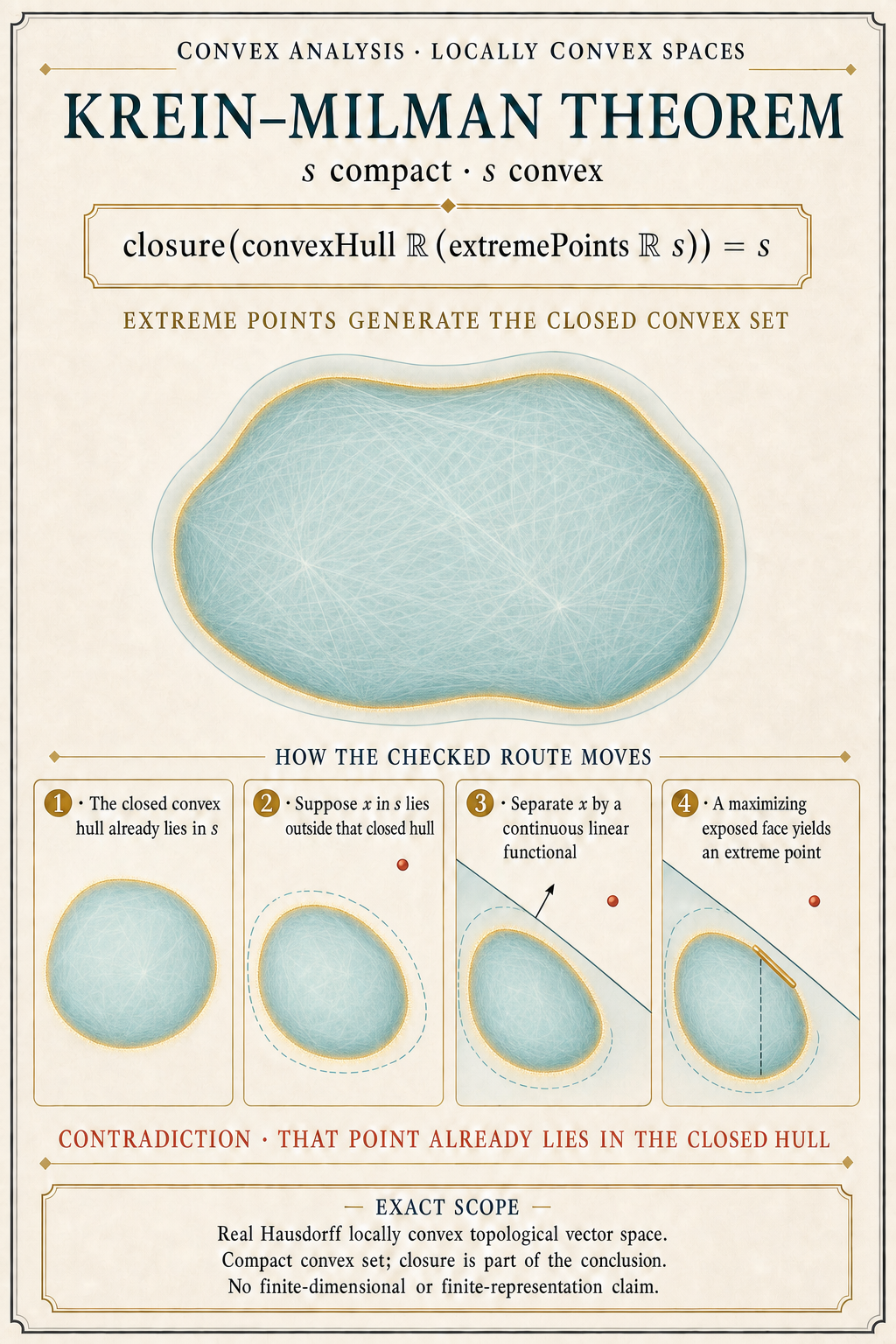
Detailed visual description
The central body uses a continuous extreme-boundary glow and dense chord laminations rather than a finite generator set. Four panels follow the source route: the easy inclusion, a hypothetical point outside the closed hull, continuous-linear-functional separation, and an exposed maximizing face whose extreme point already belongs to the closed hull.
Formal orientation
Statement map
This deterministic map orients the reader from the mathematical summary to the pinned declaration and exact checked form. The HTML statement below is authoritative.
Krein–Milman Theorem — scientific diagram
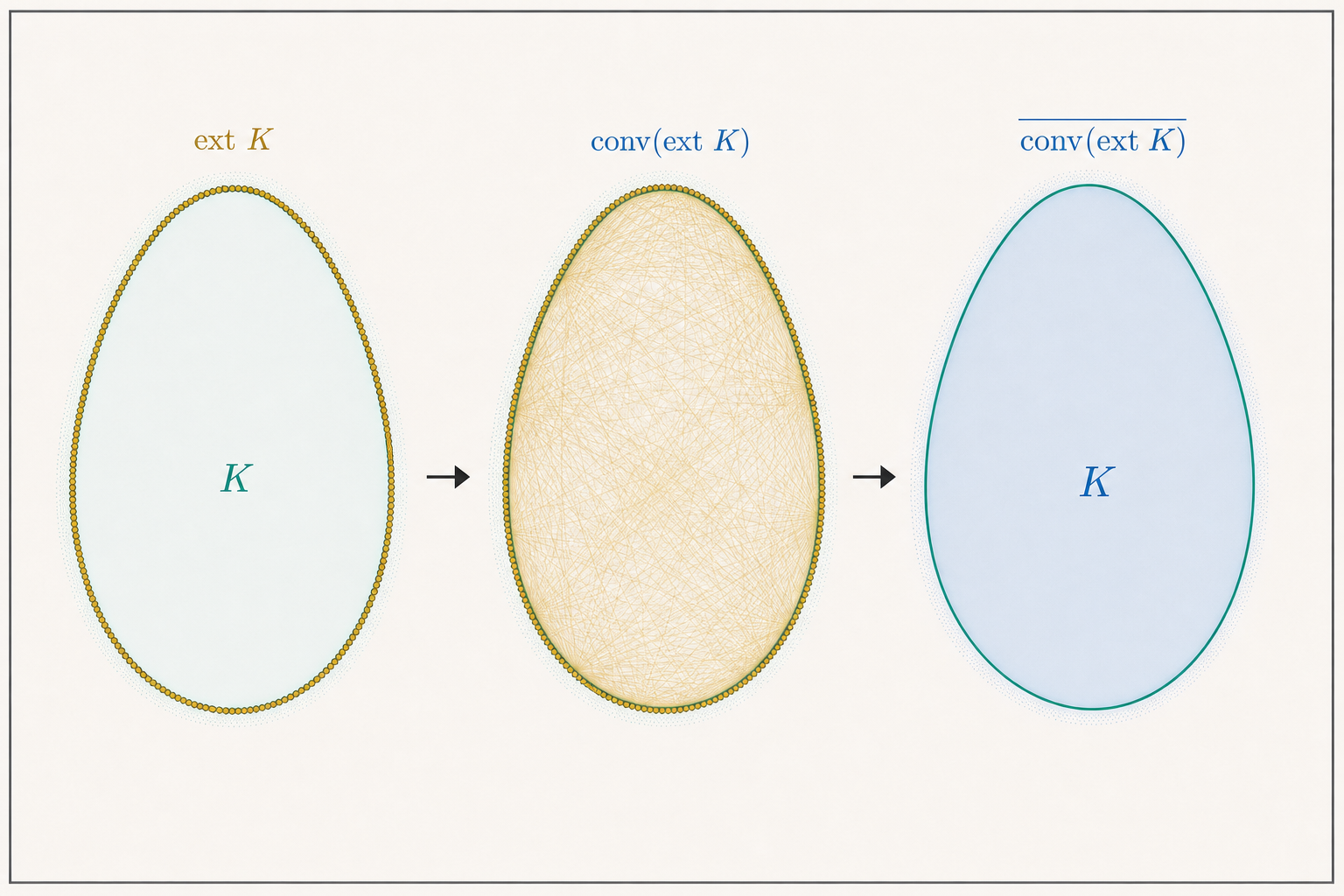
Detailed visual description
The figure uses a visually dense boundary family for ext K rather than a finite sampled polygon. Its convex combinations densely fill the interior before a separate closure stage recovers K.
Complementary intuition
A mathematical landmark
Krein–Milman is a cornerstone of infinite-dimensional convexity: it says that compact convex structure is controlled by extreme points, while the necessary closure records the genuinely topological content. Mathlib's proof exposes the central Hahn–Banach separation and extreme-face architecture.
The low-text schematic gives the theorem a visual identity; it does not replace the source-bound poster or exact statement.
Authoritative formal type
Exact Mathlib statement
theorem closure_convexHull_extremePoints {E : Type*} [AddCommGroup E] [Module ℝ E] [TopologicalSpace E] [T2Space E] [IsTopologicalAddGroup E] [ContinuousSMul ℝ E] [LocallyConvexSpace ℝ E] {s : Set E} (hscomp : IsCompact s) (hAconv : Convex ℝ s) : closure (convexHull ℝ (s.extremePoints ℝ)) = sSelected evidence declaration text
theorem closure_convexHull_extremePoints {E : Type*} [AddCommGroup E] [Module ℝ E] [TopologicalSpace E] [T2Space E] [IsTopologicalAddGroup E] [ContinuousSMul ℝ E] [LocallyConvexSpace ℝ E] {s : Set E} (hscomp : IsCompact s) (hAconv : Convex ℝ s) : closure (convexHull ℝ (s.extremePoints ℝ)) = sProofAtlas record
What has been checked
These states distinguish upstream identity, local reproduction, review, and Atlas acceptance. This page is part of the public, read-only Mathlib landmark collection.
Claim boundary
No new theorem is claimed
This page indexes Mathlib's Krein–Milman theorem in a real Hausdorff locally convex topological vector space: every compact convex set s equals closure (convexHull ℝ (s.extremePoints ℝ)). No finite-dimensional hypothesis is present, and the closure is part of the formal conclusion. The set may be empty. The selected declaration does not supply a finite convex representation, a bound on the number of extreme points, or the finite-dimensional strengthening in which closure can sometimes be removed.
- The closure in closure (convexHull ℝ (s.extremePoints ℝ)) is part of the theorem and is not removed.
- The declaration does not assume finite dimension or prove a finite-dimensional strengthening.
- It does not assert that the set of extreme points is finite or that every point has a finite or uniformly bounded extreme-point representation.
- It does not extend the equality to arbitrary noncompact convex sets.
- ProofAtlas did not originate the theorem or Mathlib's declaration, and the generated explanation and visuals are not proof evidence.
Provenance
Origin and evidence stay separate
- Existing declaration
closure_convexHull_extremePointsin mathlib- Relationship
- The checked artifact is the upstream declaration itself
- Preferred checked artifact
artifact.library.mathlib.krein-milman-theorem.v001- Source handling
- Verified upstream reference; no mirrored source package