Order theory · existing Mathlib declaration
Knaster–Tarski Theorem
For any order-preserving map from a complete lattice to itself, all points left unchanged by the map themselves form a complete lattice: every family of fixed points has both a fixed-point supremum and a fixed-point infimum.
- complete lattice
- monotone self-map
- fixed-point subtype
- least and greatest fixed points
- arbitrary suprema and infima
The theorem at a glance
Knaster–Tarski at a glance
A source-bound editorial overview of the exact Mathlib formulation. The image is explanatory; the statement map, formal type, and pinned source remain authoritative.
Knaster–Tarski at a glance
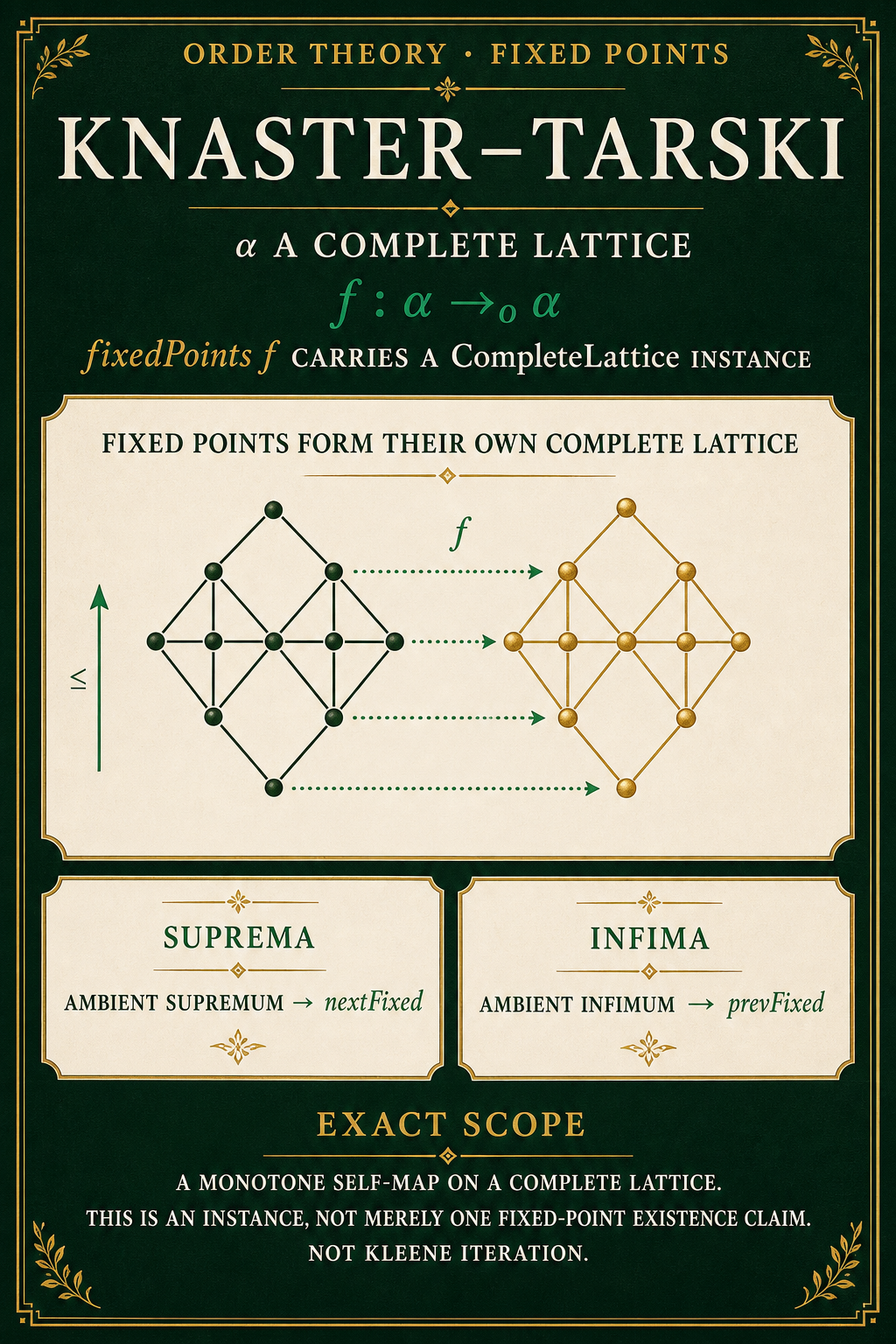
Detailed visual description
The source-bound poster presents the complete-lattice hypothesis, bundled monotone endomap, fixed-point complete-lattice instance, dual supremum and infimum constructions, and an exact-scope footer excluding one-point-only and Kleene-iteration readings.
Formal orientation
Statement map
This deterministic map orients the reader from the mathematical summary to the pinned declaration and exact checked form. The HTML statement below is authoritative.
Knaster–Tarski Theorem — scientific diagram
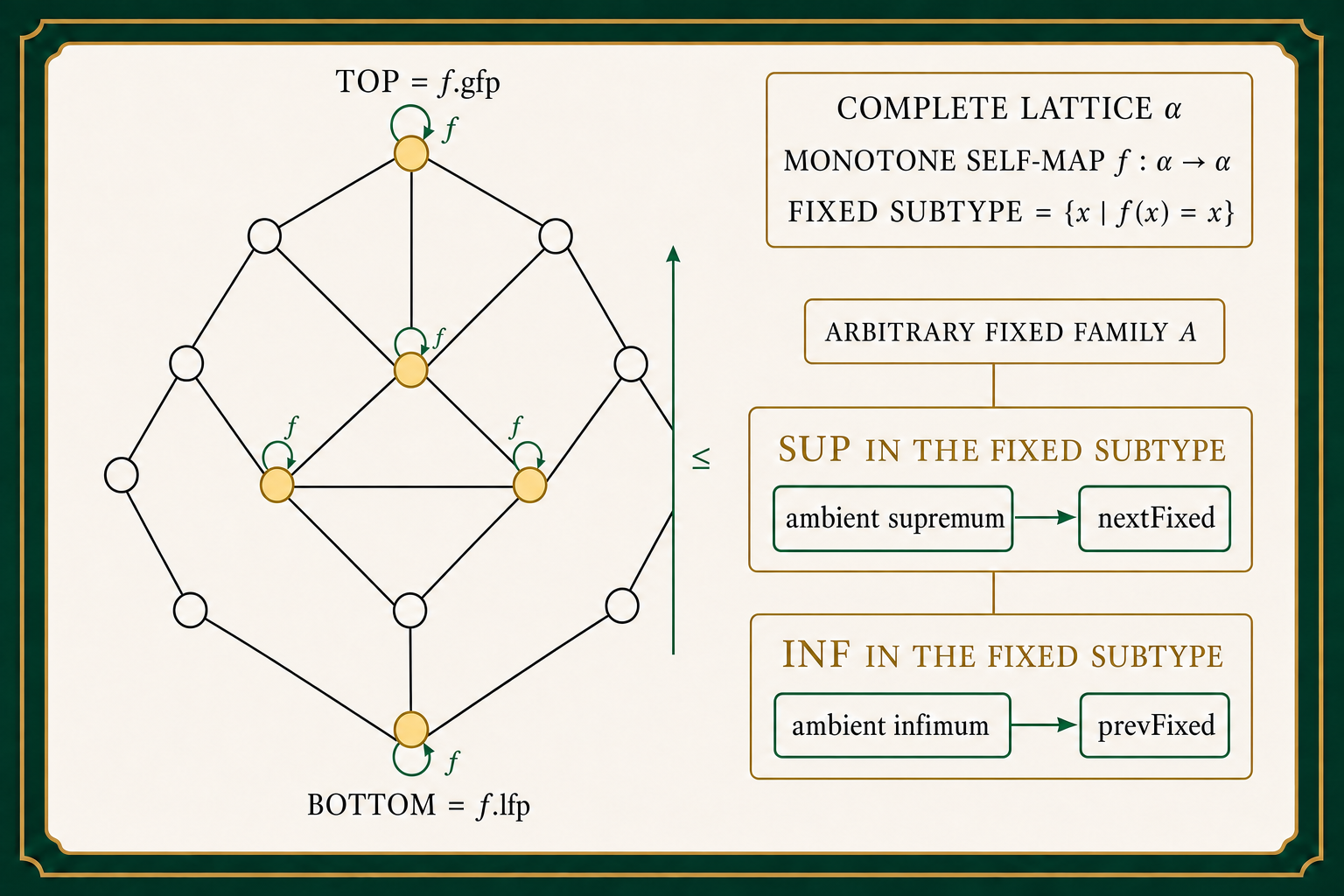
Detailed visual description
This target indexes Mathlib's structure-producing instance for the fixed-point subtype of a bundled monotone self-map of a complete lattice. It gives that subtype a CompleteLattice instance; it is not merely a one-fixed-point existence theorem and does not state the separate Kleene iteration result that follows later in the source file.
Complementary intuition
A mathematical landmark
Knaster–Tarski turns monotonicity and completeness into an entire lattice of solutions. It is foundational in order theory and supports fixed-point semantics across logic, program verification, recursive definitions, and theoretical computer science.
The low-text schematic gives the theorem a visual identity; it does not replace the source-bound poster or exact statement.
Authoritative formal type
Exact Mathlib statement
instance fixedPoints.completeLattice {α : Type u} [CompleteLattice α] (f : α →o α) : CompleteLattice (Function.fixedPoints f)Selected evidence declaration text
instance fixedPoints.completeLattice {α : Type u} [CompleteLattice α] (f : α →o α) : CompleteLattice (Function.fixedPoints f)ProofAtlas record
What has been checked
These states distinguish upstream identity, local reproduction, review, and Atlas acceptance. This page is part of the public, read-only Mathlib landmark collection.
Claim boundary
No new theorem is claimed
This target indexes Mathlib's structure-producing instance for the fixed-point subtype of a bundled monotone self-map of a complete lattice. It gives that subtype a CompleteLattice instance; it is not merely a one-fixed-point existence theorem and does not state the separate Kleene iteration result that follows later in the source file.
- The selected declaration is an instance giving CompleteLattice structure to Function.fixedPoints f, not merely a proposition asserting existence of one fixed point.
- It does not assert uniqueness, convergence, continuity, or an algorithm for computing fixed points.
- It is not Mathlib's separate Kleene fixed-point theorem or an iteration formula.
- ProofAtlas is indexing an existing Mathlib declaration, not claiming new mathematics or new proof evidence.
Provenance
Origin and evidence stay separate
- Existing declaration
fixedPoints.completeLatticein mathlib- Relationship
- The checked artifact is the upstream declaration itself
- Preferred checked artifact
artifact.library.mathlib.knaster-tarski-theorem.v001- Source handling
- Verified upstream reference; no mirrored source package