Complex analysis · existing Mathlib declaration
Holomorphic Open Mapping Theorem
An analytic map from a complex normed space into the complex plane has only two behaviors on a preconnected set: it is constant there, or it sends every ambient-open piece lying inside that set to an open region.
- holomorphic functions
- open mappings
- preconnected sets
- isolated zeros
- maximum principle
- complex-line restrictions
The theorem at a glance
Holomorphic Open Mapping Theorem at a glance
A source-bound editorial overview of the exact Mathlib formulation. The image is explanatory; the statement map, formal type, and pinned source remain authoritative.
Holomorphic Open Mapping Theorem at a glance
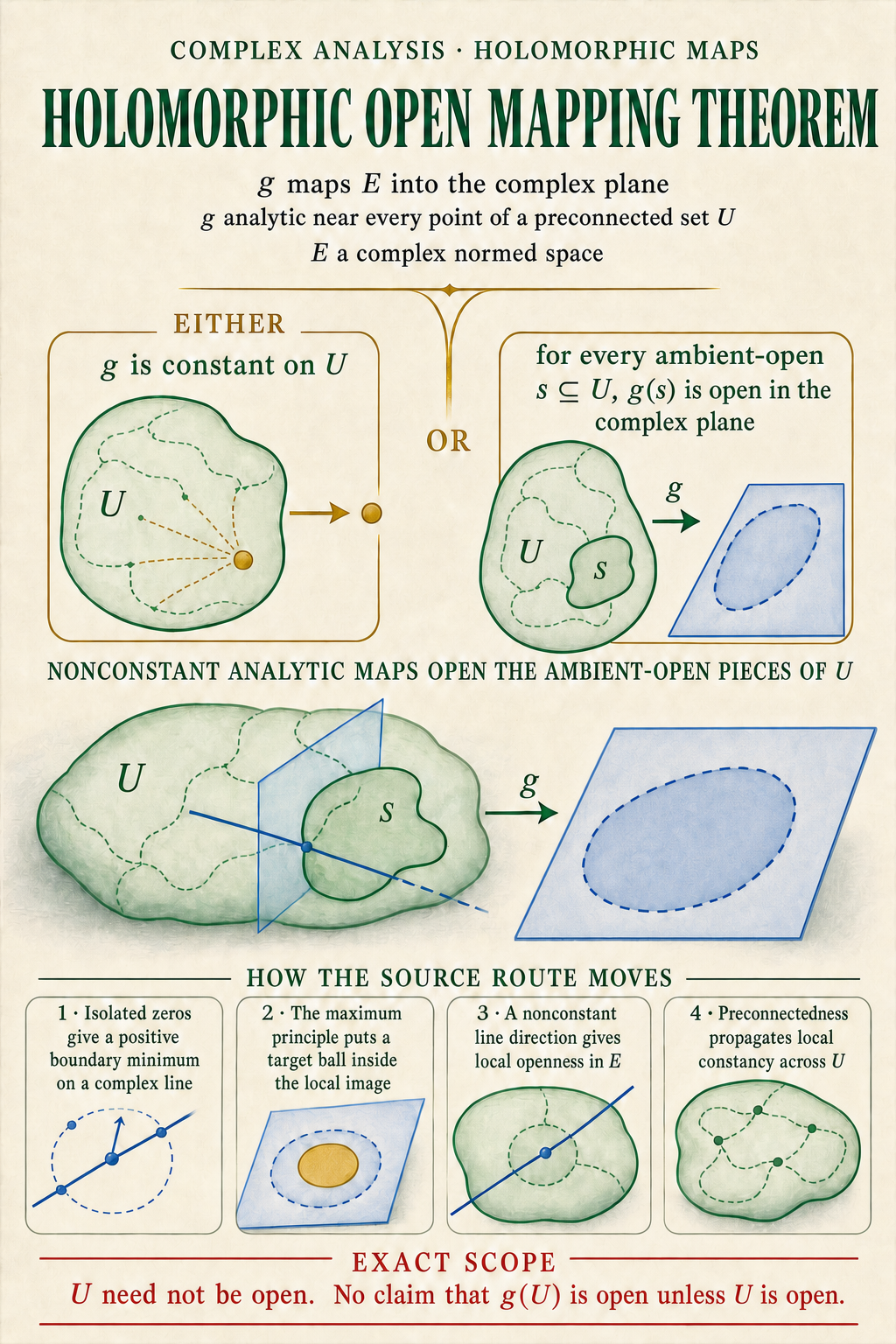
Detailed visual description
The poster keeps the higher-dimensional complex normed domain and scalar complex codomain visible, separates the constant and open alternatives, depicts one ambient-open subset inside U, and closes with the exact warning that U itself need not be open.
Formal orientation
Statement map
This deterministic map orients the reader from the mathematical summary to the pinned declaration and exact checked form. The HTML statement below is authoritative.
Holomorphic Open Mapping Theorem — scientific diagram
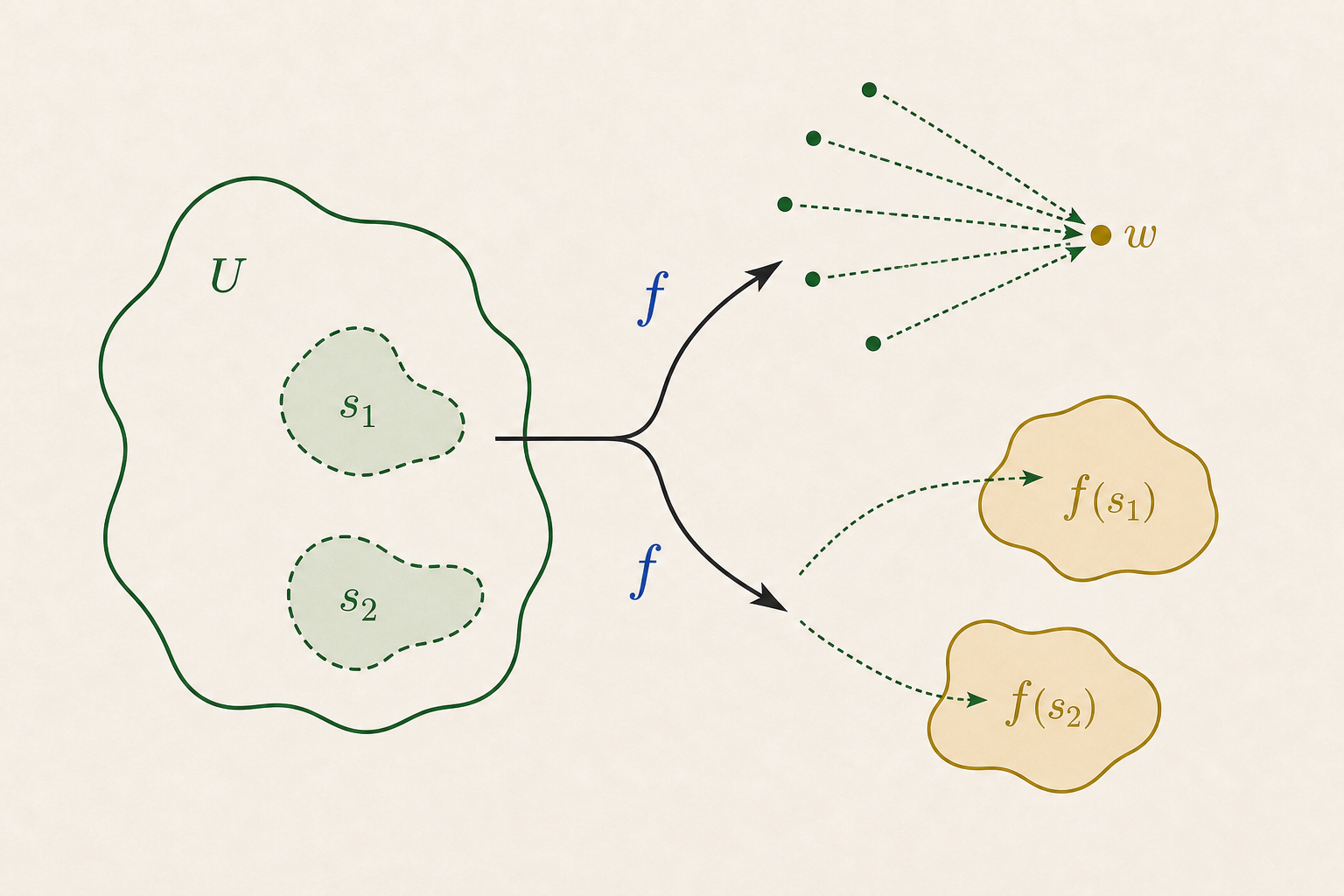
Detailed visual description
The figure separates the exact Mathlib disjunction. One branch sends all points of the preconnected set U to one value w. The other maps only the ambient-open pieces s₁ and s₂ contained in U to open regions f(s₁) and f(s₂); it does not depict U as open or claim that f(U) is open.
Complementary intuition
A mathematical landmark
The open mapping theorem is a central rigidity principle of complex analysis: nonconstant analytic behavior cannot flatten genuine neighborhoods. Mathlib's selected formulation exposes both the local analytic mechanism and its global propagation across a preconnected set, while allowing a higher-dimensional complex normed domain.
The low-text schematic gives the theorem a visual identity; it does not replace the source-bound poster or exact statement.
Authoritative formal type
Exact Mathlib statement
theorem AnalyticOnNhd.is_constant_or_isOpen {E : Type*} [NormedAddCommGroup E] [NormedSpace ℂ E] {U : Set E} {g : E → ℂ} (hg : AnalyticOnNhd ℂ g U) (hU : IsPreconnected U) : (∃ w, ∀ z ∈ U, g z = w) ∨ ∀ s ⊆ U, IsOpen s → IsOpen (g '' s)Selected evidence declaration text
theorem AnalyticOnNhd.is_constant_or_isOpen {E : Type*} [NormedAddCommGroup E] [NormedSpace ℂ E] {U : Set E} {g : E → ℂ} (hg : AnalyticOnNhd ℂ g U) (hU : IsPreconnected U) : (∃ w, ∀ z ∈ U, g z = w) ∨ ∀ s ⊆ U, IsOpen s → IsOpen (g '' s)ProofAtlas record
What has been checked
These states distinguish upstream identity, local reproduction, review, and Atlas acceptance. This page is part of the public, read-only Mathlib landmark collection.
Claim boundary
No new theorem is claimed
This page indexes Mathlib's global holomorphic open-mapping declaration for a map g from a complex normed space E to ℂ that is analytic on a neighborhood of every point of a preconnected set U. It proves a disjunction: either g is constant on U, or the image of every ambient-open subset s contained in U is open in ℂ. It does not require U to be open, assert that g(U) is open when U is not open, state a global IsOpenMap result, or allow an arbitrary vector-valued codomain.
- The set U is assumed preconnected but need not be open; the selected declaration therefore does not conclude that g(U) is open unless U is open.
- The open alternative ranges over ambient-open subsets s contained in U and is not itself a global IsOpenMap statement.
- The domain may be an arbitrary complex normed space, but the codomain in the selected declaration is exactly ℂ rather than an arbitrary complex normed space.
- The conclusion does not assert injectivity, conformality, biholomorphic inversion, or a quantitative distortion bound.
- Proof Atlas is indexing an existing Mathlib theorem, and the generated explanation and visuals are not proof evidence.
Provenance
Origin and evidence stay separate
- Existing declaration
AnalyticOnNhd.is_constant_or_isOpenin mathlib- Relationship
- The checked artifact is the upstream declaration itself
- Preferred checked artifact
artifact.library.mathlib.holomorphic-open-mapping-theorem.v001- Source handling
- Verified upstream reference; no mirrored source package