Algebra · existing Mathlib declaration
Hilbert Basis Theorem
If every ideal in a commutative ring can be generated by finitely many elements, the same remains true after adjoining one polynomial variable.
- Hilbert basis theorem
- Noetherian rings
- univariate polynomial rings
- finitely generated ideals
- leading coefficients
- degree induction
The theorem at a glance
Hilbert Basis Theorem — finite generation survives one polynomial variable
A source-bound editorial overview of the exact Mathlib formulation. The image is explanatory; the statement map, formal type, and pinned source remain authoritative.
Hilbert Basis Theorem — finite generation survives one polynomial variable
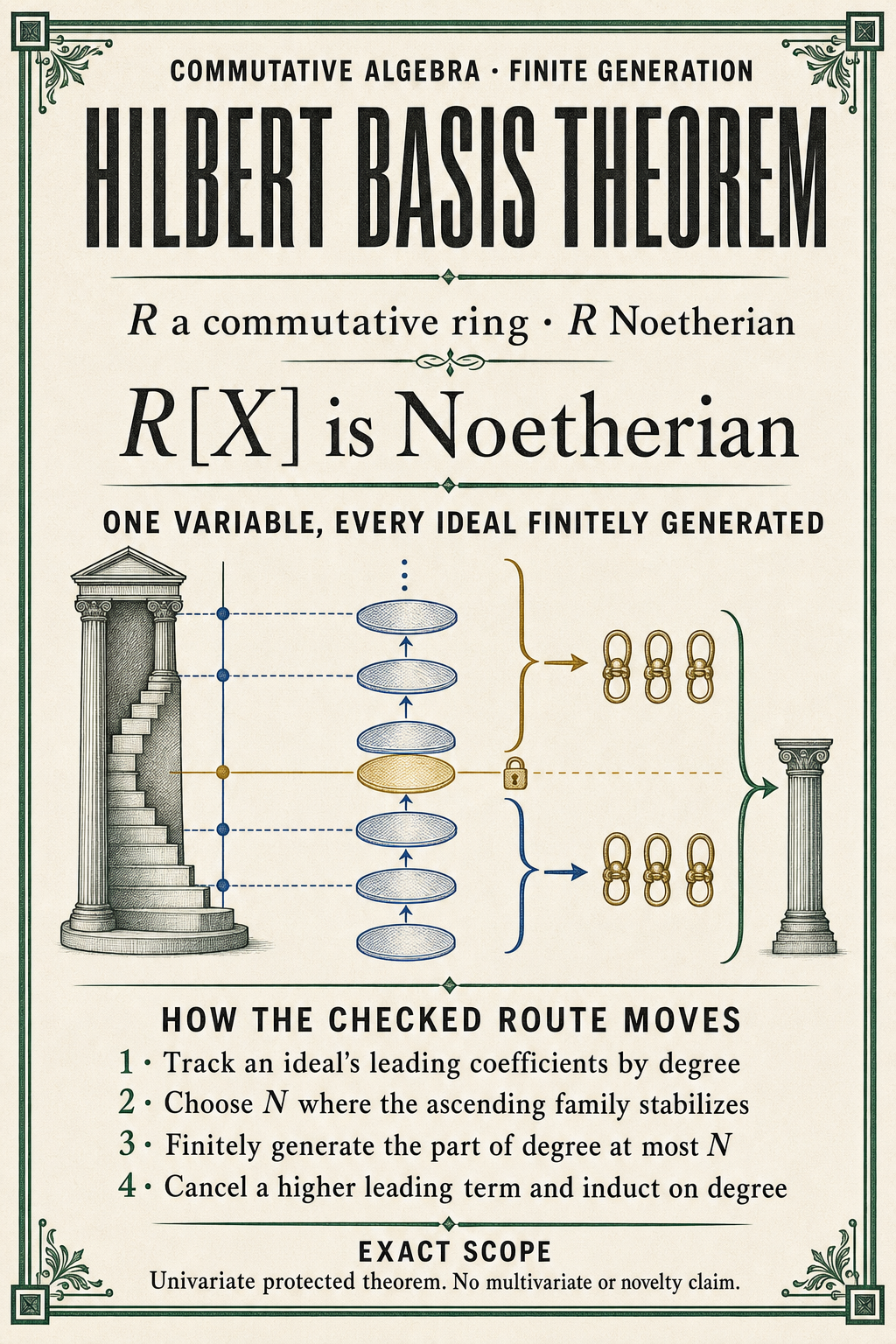
Detailed visual description
The poster centers the exact transfer R Noetherian to R[X] Noetherian. Its engraved proof route tracks leading coefficients by degree, marks a stabilization threshold, finitely generates the bounded-degree part, and cancels higher leading terms to induct downward in degree.
Formal orientation
Statement map
This deterministic map orients the reader from the mathematical summary to the pinned declaration and exact checked form. The HTML statement below is authoritative.
Hilbert Basis Theorem — scientific diagram
![Passed full-canvas review and lossless 1:1 quadrant inspection. The distinct Scientific diagram gives a precise left-to-right dependency route from R NOETHERIAN through the leading-coefficient chain and its stable plateau, a visibly finite bounded-degree generator set, leading-term cancellation with degree descent, I = span(s), and the exact R[X] NOETHERIAN endpoint. Every required label is complete and legible, the one-variable structure is explicit, the targeted correction preserves ⊆ and removes the stray subtraction glyph, and there is no multivariable, field-only, algorithmic, or novelty overclaim.](/assets/theorem-visual-styles/scientific-v1/mathlib/hilbert-basis-theorem/theorem-schematic-scientific-v1.png)
Detailed visual description
This target indexes Mathlib's protected theorem that a commutative Noetherian ring R has a Noetherian univariate polynomial ring R[X]. The conclusion is the IsNoetherianRing R[X] typeclass proposition, and the source registers the theorem as an instance on the following line. It is not a multivariate endpoint, a generator-computation algorithm, or new ProofAtlas mathematics.
Complementary intuition
A mathematical landmark
Hilbert's basis theorem is a foundational finiteness result in commutative algebra: adjoining one polynomial variable preserves the Noetherian condition and keeps every polynomial ideal finitely generated.
The low-text schematic gives the theorem a visual identity; it does not replace the source-bound poster or exact statement.
Authoritative formal type
Exact Mathlib statement
protected theorem Polynomial.isNoetherianRing {R : Type u} [CommRing R] [inst : IsNoetherianRing R] : IsNoetherianRing R[X]Selected evidence declaration text
protected theorem Polynomial.isNoetherianRing {R : Type u} [CommRing R] [inst : IsNoetherianRing R] : IsNoetherianRing R[X]ProofAtlas record
What has been checked
These states distinguish upstream identity, local reproduction, review, and Atlas acceptance. This page is part of the public, read-only Mathlib landmark collection.
Claim boundary
No new theorem is claimed
This target indexes Mathlib's protected theorem that a commutative Noetherian ring R has a Noetherian univariate polynomial ring R[X]. The conclusion is the IsNoetherianRing R[X] typeclass proposition, and the source registers the theorem as an instance on the following line. It is not a multivariate endpoint, a generator-computation algorithm, or new ProofAtlas mathematics.
- The exact declaration adjoins one polynomial variable; it does not itself state a multivariable polynomial theorem.
- The theorem produces a typeclass proposition, not an explicit algorithm for computing generators of an ideal.
- The source assumes a commutative ring; this page does not extend the result to arbitrary semirings or noncommutative polynomial constructions.
- ProofAtlas is indexing an existing Mathlib theorem, not claiming mathematical novelty.
Provenance
Origin and evidence stay separate
- Existing declaration
Polynomial.isNoetherianRingin mathlib- Relationship
- The checked artifact is the upstream declaration itself
- Preferred checked artifact
artifact.library.mathlib.hilbert-basis-theorem.v001- Source handling
- Verified upstream reference; no mirrored source package