Algebra and complex analysis · existing Mathlib theorem
Fundamental Theorem of Algebra
Take a polynomial whose coefficients and inputs are complex numbers. If its degree is positive, then at least one complex number makes the polynomial equal to zero.
Accepted Atlas resultNot recorded for the preferred artifact
These states distinguish upstream identity, local reproduction, review, and Atlas acceptance. This page is part of the public, read-only Mathlib landmark collection.
Formal orientation
Statement map
This deterministic map orients the reader from the mathematical summary to the pinned declaration and exact checked form. The HTML statement below is authoritative.
The theorem at a glance
Fundamental Theorem of Algebra at a glance
A source-bound editorial overview of the exact Mathlib formulation. The image is explanatory; the statement map, formal type, and pinned source remain authoritative.
Fundamental Theorem of Algebra at a glance
Loading full-resolution image…
Positive degree leads to the existence of at least one complex root; the poster visibly limits the claim to root existence.Open original image in a new tab ↗
Positive degree leads to the existence of at least one complex root; the poster visibly limits the claim to root existence. Generated explanation only; the exact HTML statement and pinned source are authoritative.Detailed visual description
The poster places deg f > 0 on the left and the existential root formula on the right. Below, evaluation paths on a stylized complex plane converge toward one highlighted zero. A numbered reading guide and red exact-scope panel state that uniqueness, factorization, and multiplicity are not claimed.
A positive-degree complex polynomial is pictured descending to a root where it vanishes. Generated explanation only; the exact HTML statement and pinned source are authoritative.Detailed visual description
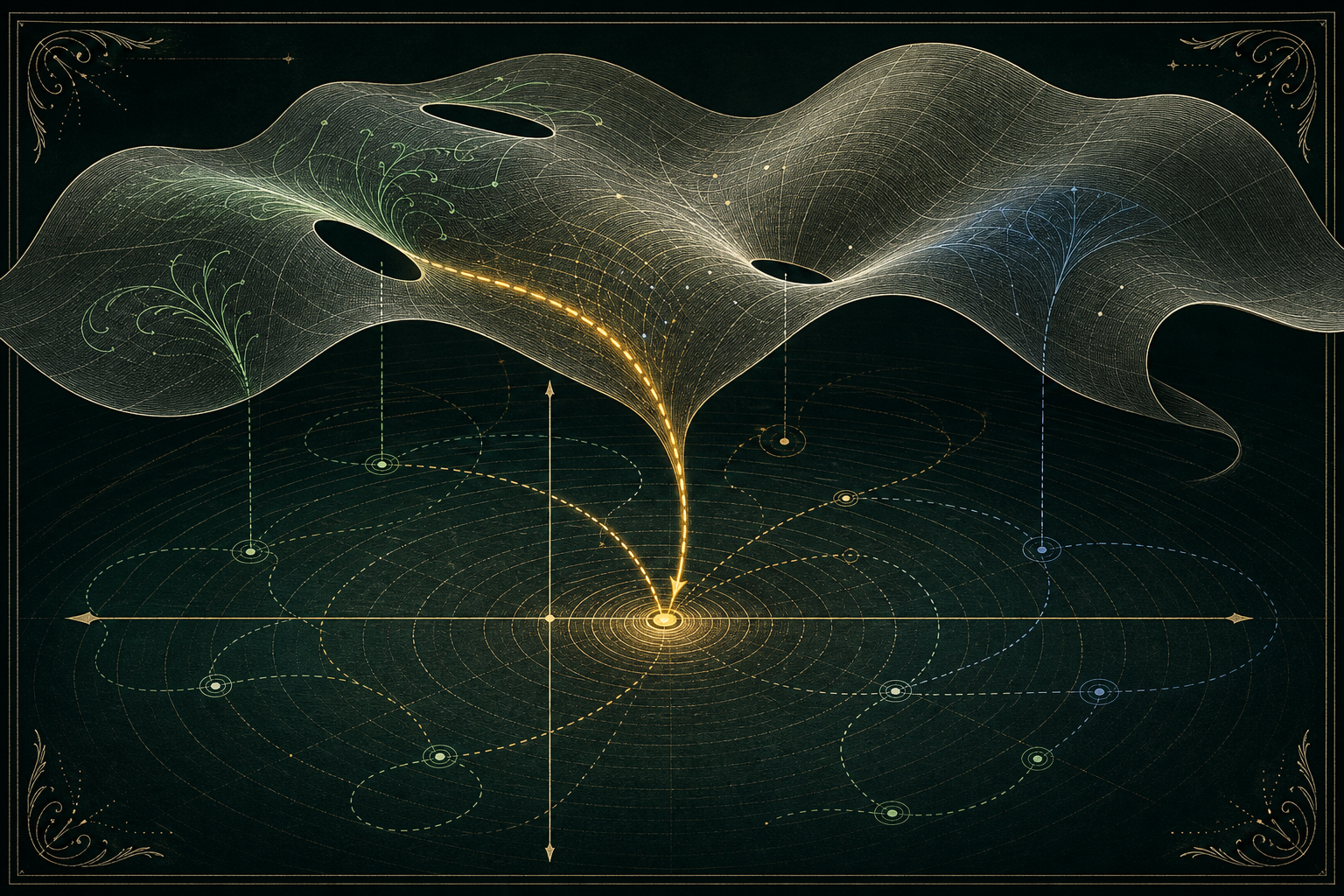
An engraved ivory surface folds across a dark complex-plane field. Emerald, cobalt, and gold trajectories descend from several sheets toward one bright central point, emphasizing existence of a root without depicting a proof.
Complementary intuition
A mathematical landmark
The theorem says that complex numbers contain the roots needed by every nonconstant one-variable complex polynomial. It is a foundational bridge between algebra and complex analysis.
The low-text schematic gives the theorem a visual identity; it does not replace the source-bound poster or exact statement.
Mathlib proves the exact root-existence theorem by assuming a positive-degree complex polynomial has no root, studying its differentiable reciprocal, using polynomial growth and Liouville's theorem to force that reciprocal to vanish everywhere, and deriving the impossible conclusion that the polynomial is the zero constant.
These source-anchored stages explain the retained Mathlib proof route. They are generated explanations, not proof evidence or an extracted Lean proof-term dependency graph.
01
Assume the positive-degree polynomial has no root
Assume the positive-degree polynomial has no root
Loading full-resolution image…
Assume for contradiction that the positive-degree complex polynomial never vanishes, so its evaluation ribbon avoids the root socket everywhere.Open original image in a new tab ↗
Assume for contradiction that the positive-degree complex polynomial never vanishes, so its evaluation ribbon avoids the root socket everywhere.
0 < f.degree and ∀ z : ℂ, f.eval z ≠ 0
The proof begins by negating the desired root existence. Under this contradiction hypothesis, f.eval z is nonzero for every complex z, which supplies the pointwise nonvanishing condition needed to differentiate its reciprocal.
02
Reciprocal decay follows polynomial growth
Reciprocal decay follows polynomial growth
Loading full-resolution image…
With no zero to obstruct inversion, the reciprocal is differentiable; polynomial growth at infinity becomes reciprocal decay to zero.Open original image in a new tab ↗
With no zero to obstruct inversion, the reciprocal is differentiable; polynomial growth at infinity becomes reciprocal decay to zero.
‖f(z)‖ → ∞ and (f.eval z)⁻¹ → 0 as z tends to complex infinity
Because f.eval is everywhere nonzero, its reciprocal is differentiable. Positive degree makes the norm of the polynomial tend to infinity along the complex cobounded filter, and inversion turns that growth into convergence of the reciprocal to zero.
03
Liouville forces the reciprocal to vanish everywhere
Liouville forces the reciprocal to vanish everywhere
Loading full-resolution image…
A differentiable reciprocal that tends to zero at complex infinity is forced by Liouville's theorem to equal zero at every point.Open original image in a new tab ↗
A differentiable reciprocal that tends to zero at complex infinity is forced by Liouville's theorem to equal zero at every point.
∀ z : ℂ, (f.eval z)⁻¹ = 0
Mathlib applies the Liouville consequence apply_eq_of_tendsto_cocompact to the differentiable reciprocal and its limit at complex infinity. The conclusion is pointwise and global: for every complex z, the reciprocal of f.eval z equals zero.
04
The zero polynomial contradiction reveals a root
The zero polynomial contradiction reveals a root
Loading full-resolution image…
Pointwise zero reciprocals force the polynomial to be the zero constant, contradicting positive degree; therefore a complex root exists.Open original image in a new tab ↗
Pointwise zero reciprocals force the polynomial to be the zero constant, contradicting positive degree; therefore a complex root exists.
f = C 0, contradicting 0 < f.degree; hence ∃ z : ℂ, f.IsRoot z
Inverse injectivity and polynomial extensionality turn the pointwise reciprocal equation into f = C 0. That makes the polynomial's degree incompatible with the original positive-degree hypothesis, so the rootless assumption is false and a complex root exists.
Claim boundary
No new theorem is claimed
This page indexes Mathlib's exact existence theorem for a root of a positive-degree complex polynomial. It does not by itself state complete linear factorization, count roots with multiplicity, claim a new proof, or transfer any accepted-result status.
Proof Atlas did not originate the Fundamental Theorem of Algebra or Mathlib's declaration.
The direct Mathlib evidence is a local reproduction of an upstream theorem, not a new formalization.
The generated explanation and visual are not proof evidence.