Combinatorics · existing Mathlib declaration
Euler’s Odd–Distinct Partition Theorem
Fix a natural number n. Count the partitions of n made only from odd numbers, allowing repeats. Then count the partitions of n in which no number repeats, allowing both odd and even parts. Euler’s theorem says the two counts are always equal.
- integer partitions
- odd parts
- distinct parts
- generating functions
- Glaisher’s theorem
The theorem at a glance
Euler’s Odd–Distinct Partition Theorem at a glance
A source-bound editorial overview of the exact Mathlib formulation. The image is explanatory; the statement map, formal type, and pinned source remain authoritative.
Euler’s Odd–Distinct Partition Theorem at a glance
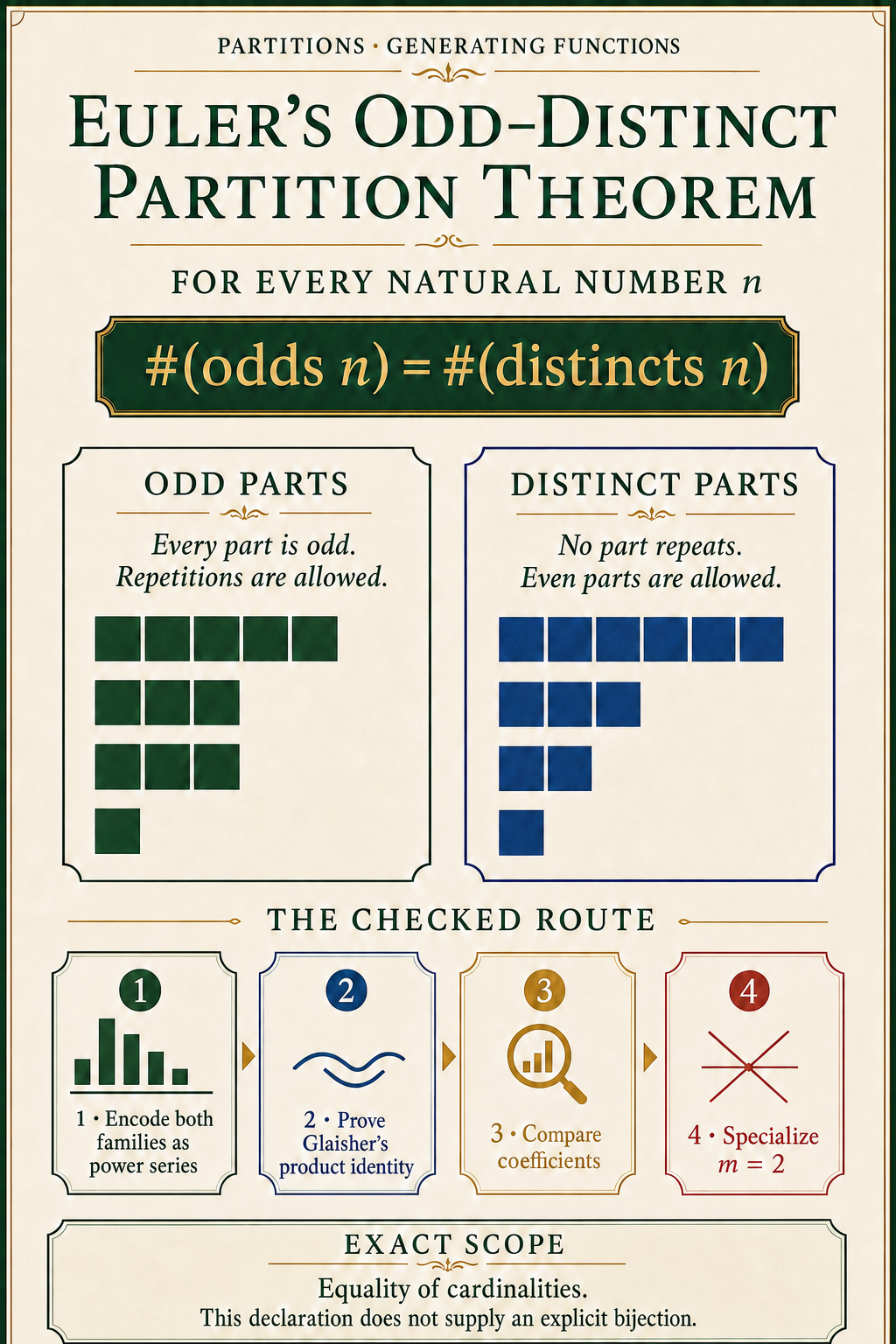
Detailed visual description
The poster defines both finite partition families, gives their cardinality equality for every natural n, and traces the Mathlib proof from restricted-partition power series through Glaisher’s product identity and coefficient comparison to the m = 2 specialization. Its scope footer states that the declaration proves a count equality rather than providing an explicit bijection.
Formal orientation
Statement map
This deterministic map orients the reader from the mathematical summary to the pinned declaration and exact checked form. The HTML statement below is authoritative.
Euler’s Odd–Distinct Partition Theorem — scientific diagram
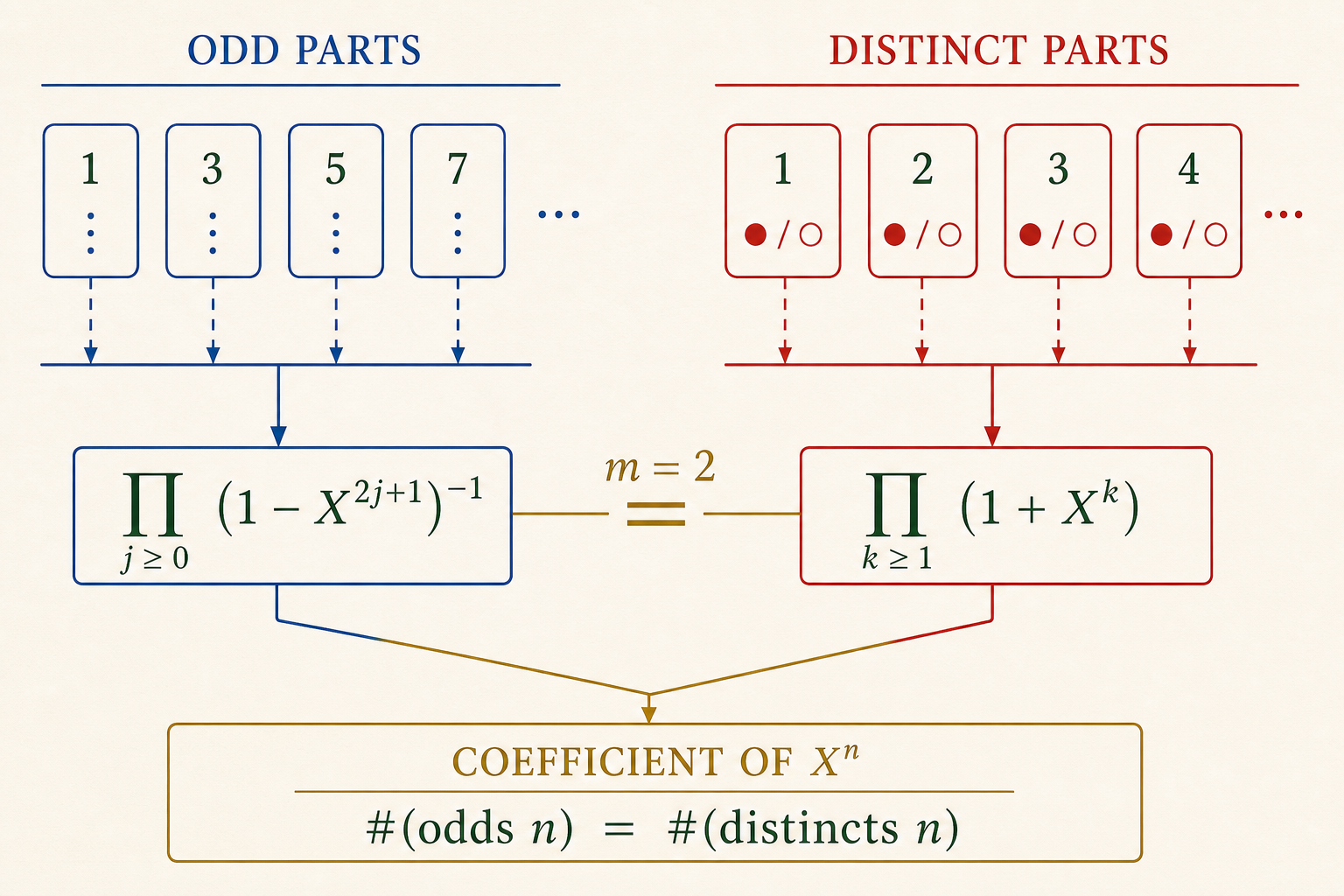
Detailed visual description
This page indexes Mathlib’s cardinality form of Euler’s partition theorem. For every natural n, odds n is the finite set of partitions of n all of whose parts are odd, while distincts n is the finite set of partitions of n whose parts multiset has no repetitions. The declaration says that these two finite sets have equal cardinality. It does not itself construct an explicit bijection, enumerate either family, or state a broader partition identity.
Complementary intuition
A mathematical landmark
Euler’s odd-versus-distinct partition identity is a foundational equinumerosity theorem in enumerative combinatorics. The Mathlib endpoint is concise, but it rests on a substantial generating-function development proving Glaisher’s more general restriction theorem and then specializing it at two.
The low-text schematic gives the theorem a visual identity; it does not replace the source-bound poster or exact statement.
Authoritative formal type
Exact Mathlib statement
theorem Nat.Partition.card_odds_eq_card_distincts (n : ℕ) : #(Nat.Partition.odds n) = #(Nat.Partition.distincts n)Selected evidence declaration text
theorem Nat.Partition.card_odds_eq_card_distincts (n : ℕ) : #(Nat.Partition.odds n) = #(Nat.Partition.distincts n)ProofAtlas record
What has been checked
These states distinguish upstream identity, local reproduction, review, and Atlas acceptance. This page is part of the public, read-only Mathlib landmark collection.
Claim boundary
No new theorem is claimed
This page indexes Mathlib’s cardinality form of Euler’s partition theorem. For every natural n, odds n is the finite set of partitions of n all of whose parts are odd, while distincts n is the finite set of partitions of n whose parts multiset has no repetitions. The declaration says that these two finite sets have equal cardinality. It does not itself construct an explicit bijection, enumerate either family, or state a broader partition identity.
- The selected declaration proves equality of cardinalities, not an explicit bijection between individual partitions.
- The odd-parts family allows repetitions; only the numerical value of every part must be odd.
- The distinct-parts family permits even parts; its restriction is that no part repeats.
- The checked source proves the result through generating functions and Glaisher’s theorem specialized to m = 2.
- ProofAtlas is indexing an existing Mathlib theorem, not claiming new mathematics.
Provenance
Origin and evidence stay separate
- Existing declaration
Nat.Partition.card_odds_eq_card_distinctsin mathlib- Relationship
- The checked artifact is the upstream declaration itself
- Preferred checked artifact
artifact.library.mathlib.euler-odd-distinct-partitions.v001- Source handling
- Verified upstream reference; no mirrored source package