Linear algebra · existing Mathlib theorem
Cayley–Hamilton Theorem
Take a linear transformation of a finite free module, form its characteristic polynomial, and substitute the transformation itself into that polynomial. The resulting endomorphism is zero.
- endomorphism
- characteristic polynomial
- polynomial evaluation
- finite free module
Four separate status axes
These states distinguish upstream identity, local reproduction, review, and Atlas acceptance. This page is part of the public, read-only Mathlib landmark collection.
Formal orientation
Statement map
This deterministic map orients the reader from the mathematical summary to the pinned declaration and exact checked form. The HTML statement below is authoritative.
The theorem at a glance
Cayley–Hamilton theorem at a glance
A source-bound editorial overview of the exact Mathlib formulation. The image is explanatory; the statement map, formal type, and pinned source remain authoritative.
Cayley–Hamilton theorem at a glance
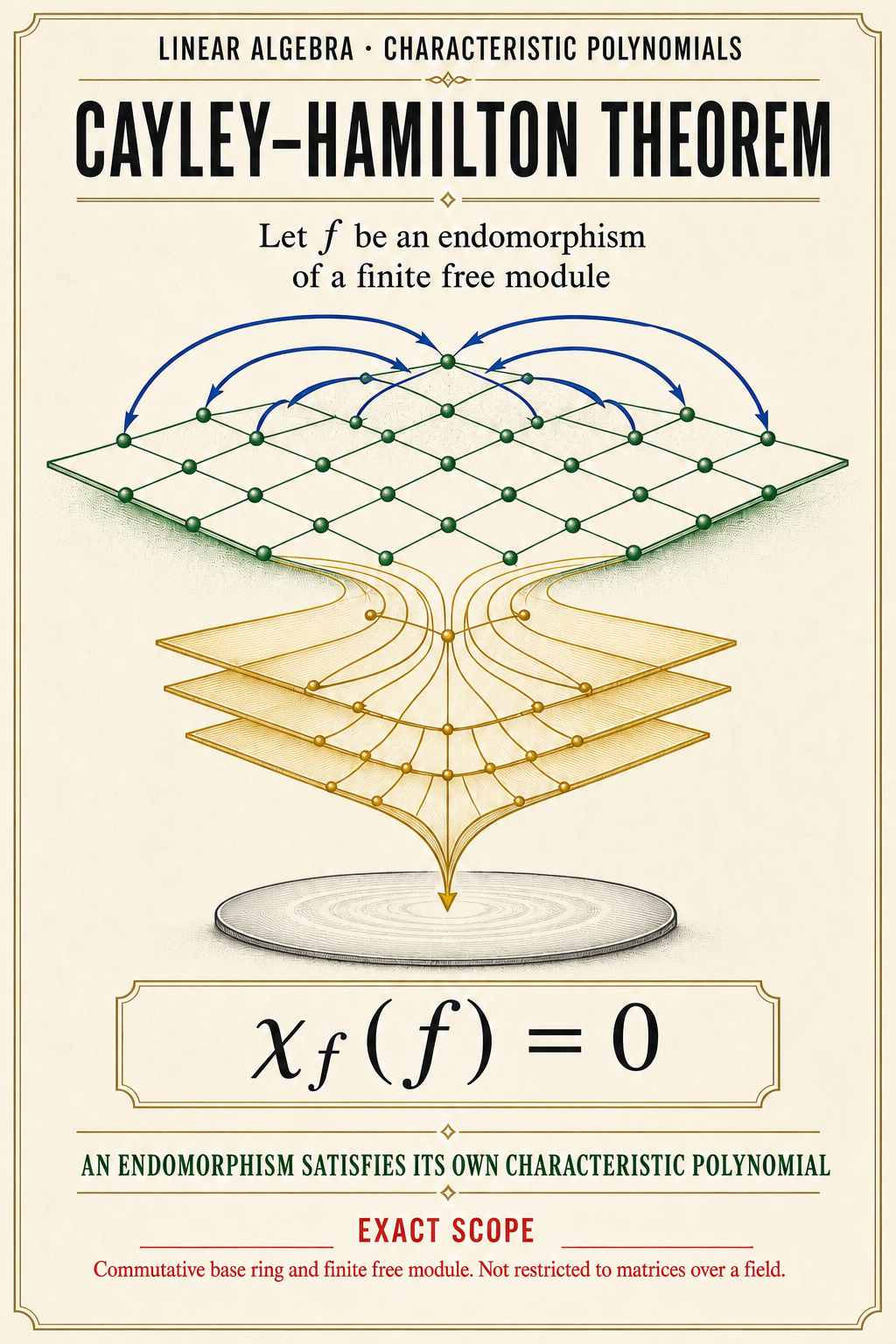
Detailed visual description
The poster distinguishes an endomorphism from the zero polynomial evaluation, shows the matrix-mediated transformation route without field-only language, and states the commutative-ring finite-free-module scope.
Cayley–Hamilton theorem schematic
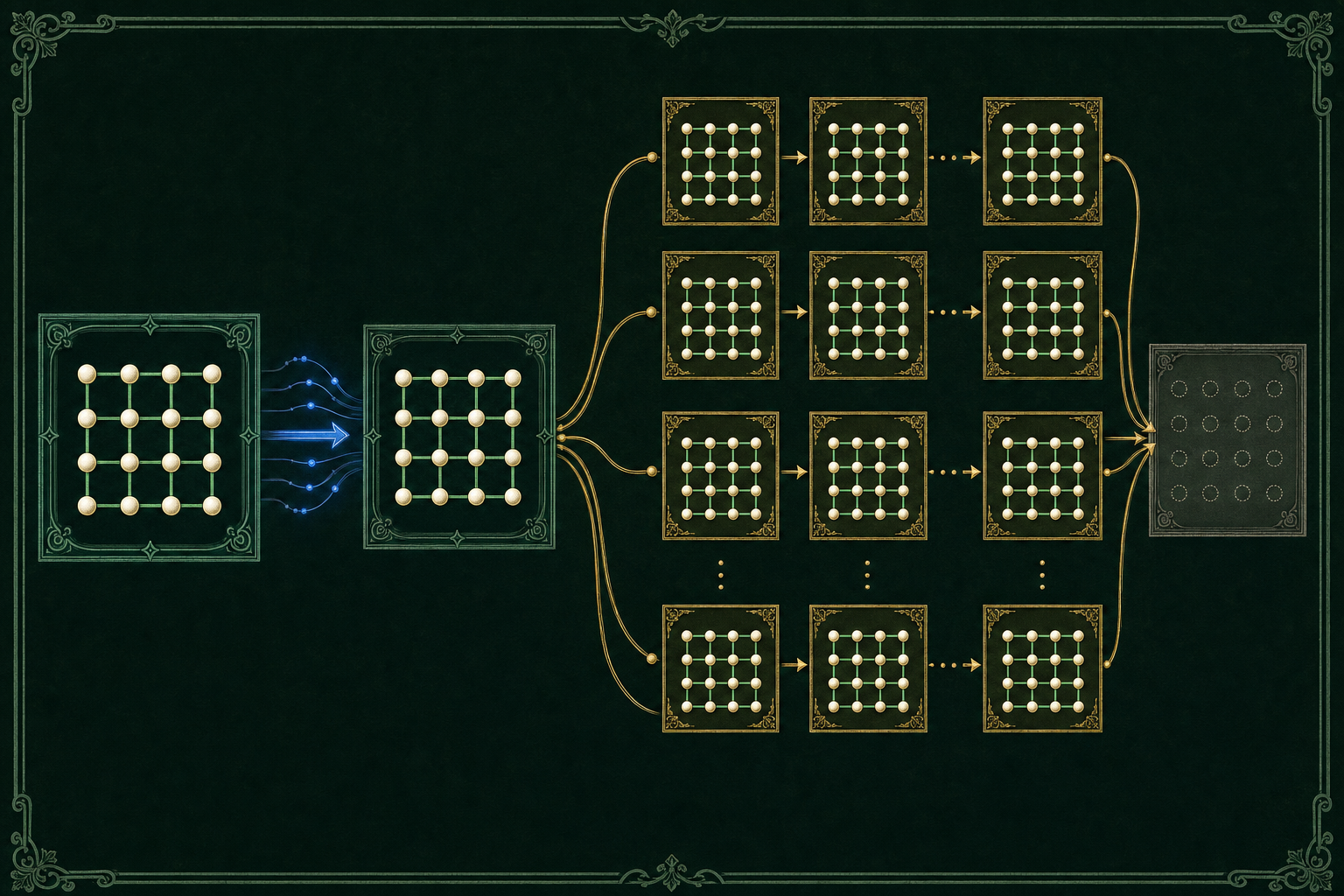
Detailed visual description
A fixed finite lattice is preserved across repeated transformation layers, then the characteristic-polynomial combination resolves to an empty lattice of zero outputs without implying that the original endomorphism is zero.
Complementary intuition
A mathematical landmark
Cayley–Hamilton binds the polynomial invariants of a linear transformation back to the transformation itself. It is a cornerstone of matrix theory and module-theoretic linear algebra.
The low-text schematic gives the theorem a visual identity; it does not replace the source-bound poster or exact statement.
Authoritative formal type
Exact Mathlib statement
theorem LinearMap.aeval_self_charpoly {R : Type*} {M : Type*} [CommRing R] [AddCommGroup M] [Module R M] [Module.Free R M] [Module.Finite R M] (f : M →ₗ[R] M) : (Polynomial.aeval f) f.charpoly = 0Selected evidence declaration text
theorem LinearMap.aeval_self_charpoly {R : Type*} {M : Type*} [CommRing R] [AddCommGroup M] [Module R M] [Module.Free R M] [Module.Finite R M] (f : M →ₗ[R] M) : (Polynomial.aeval f) f.charpoly = 0Claim boundary
No new theorem is claimed
This target indexes Mathlib's theorem that a linear endomorphism of a finite free module over a commutative ring annihilates its own characteristic polynomial. It is not restricted to matrices over a field and does not claim a new proof.
- Proof Atlas did not originate the Cayley–Hamilton theorem or Mathlib's declaration.
- The conclusion says that the characteristic polynomial evaluated at f is zero; it does not say that f itself is zero.
- The generated explanation and visuals are not proof evidence.
Provenance
Origin and evidence stay separate
- Existing declaration
LinearMap.aeval_self_charpolyin mathlib- Relationship
- The checked artifact is the upstream declaration itself
- Preferred checked artifact
artifact.library.mathlib.cayley-hamilton-theorem.v001- Source handling
- Verified upstream reference; no mirrored source package