Functional analysis · existing Mathlib declaration
Banach–Steinhaus Theorem
For each vector x, the family may need its own bound. If the source space is complete, those separate pointwise bounds force a single constant that bounds the operator norm of every map in the family.
- uniform boundedness principle
- continuous semilinear maps
- operator norms
- pointwise boundedness
- equicontinuity
- barrelled spaces
The theorem at a glance
Banach–Steinhaus theorem at a glance
A source-bound editorial overview of the exact Mathlib formulation. The image is explanatory; the statement map, formal type, and pinned source remain authoritative.
Banach–Steinhaus theorem at a glance
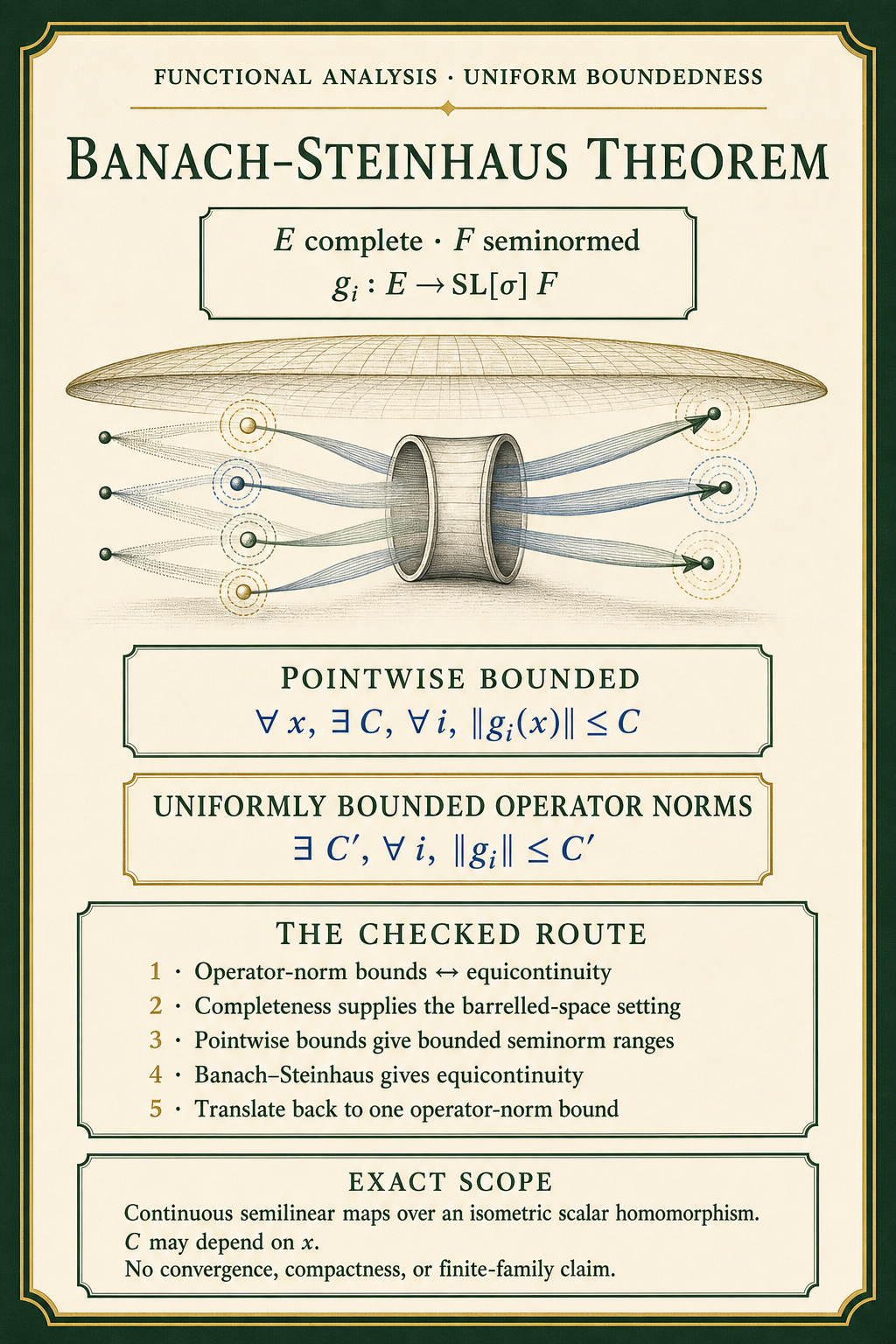
Detailed visual description
The poster keeps the source and codomain seminormed boundary visible, places the vector-dependent pointwise estimate above the uniform operator estimate, and summarizes the exact source bridge from norm bounds to equicontinuity, through the barrelled-space Banach–Steinhaus theorem, and back.
Formal orientation
Statement map
This deterministic map orients the reader from the mathematical summary to the pinned declaration and exact checked form. The HTML statement below is authoritative.
Banach–Steinhaus Theorem — scientific diagram
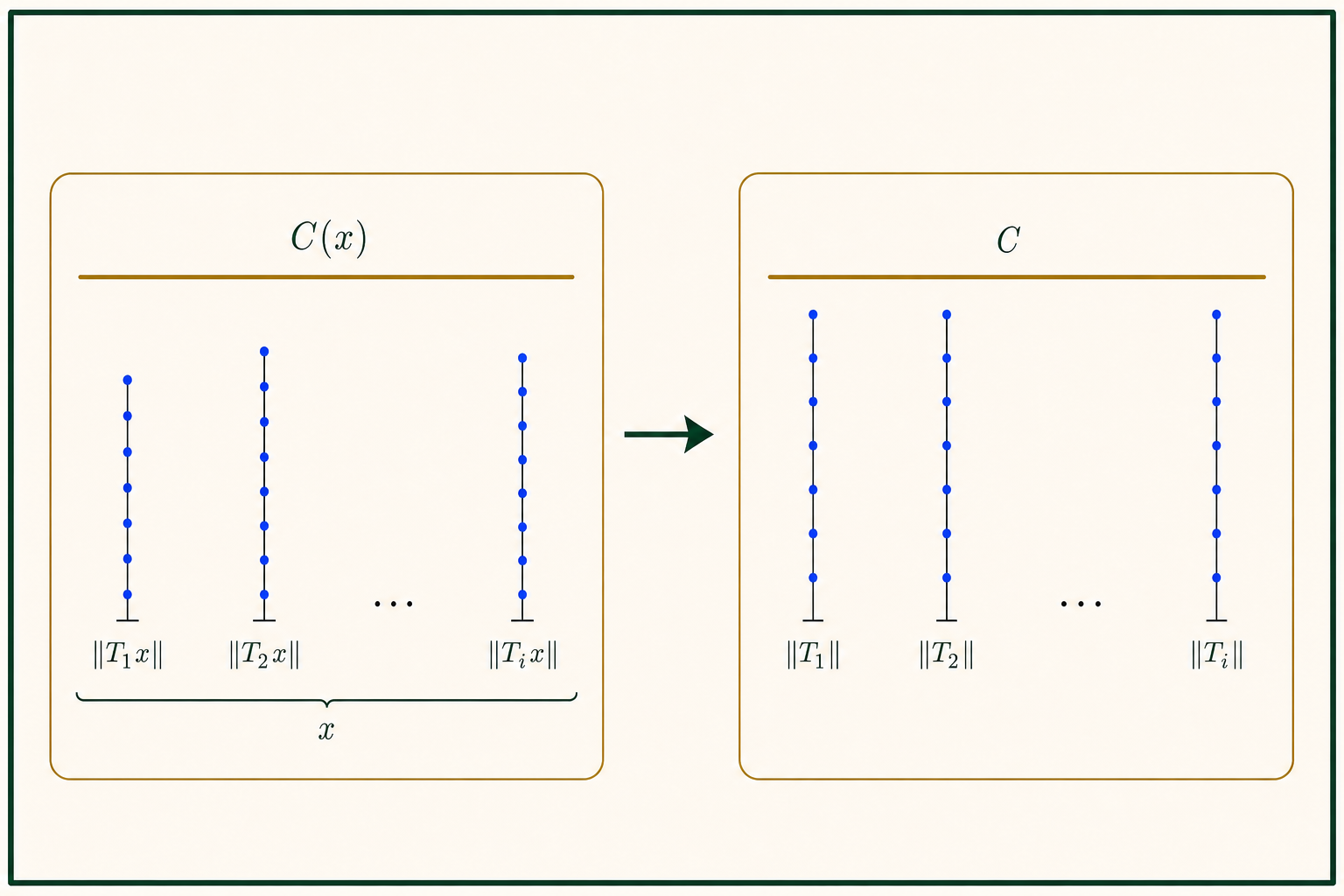
Detailed visual description
The left panel fixes one x and places several values ‖Tᵢx‖ below the same C(x), preserving the pointwise quantifiers. The right panel places the entire family's operator norms below one common C.
Complementary intuition
A mathematical landmark
Banach–Steinhaus is one of the foundational principles of functional analysis. It converts pointwise control of an entire operator family into uniform norm control, with completeness supplying the decisive global structure.
The low-text schematic gives the theorem a visual identity; it does not replace the source-bound poster or exact statement.
Authoritative formal type
Exact Mathlib statement
theorem banach_steinhaus {E F 𝕜 𝕜₂ : Type*} [SeminormedAddCommGroup E] [SeminormedAddCommGroup F] [NontriviallyNormedField 𝕜] [NontriviallyNormedField 𝕜₂] [NormedSpace 𝕜 E] [NormedSpace 𝕜₂ F] {σ₁₂ : 𝕜 →+* 𝕜₂} [RingHomIsometric σ₁₂] {ι : Type*} [CompleteSpace E] {g : ι → E →SL[σ₁₂] F} (h : ∀ x, ∃ C, ∀ i, ‖g i x‖ ≤ C) : ∃ C', ∀ i, ‖g i‖ ≤ C'Selected evidence declaration text
theorem banach_steinhaus {E F 𝕜 𝕜₂ : Type*} [SeminormedAddCommGroup E] [SeminormedAddCommGroup F] [NontriviallyNormedField 𝕜] [NontriviallyNormedField 𝕜₂] [NormedSpace 𝕜 E] [NormedSpace 𝕜₂ F] {σ₁₂ : 𝕜 →+* 𝕜₂} [RingHomIsometric σ₁₂] {ι : Type*} [CompleteSpace E] {g : ι → E →SL[σ₁₂] F} (h : ∀ x, ∃ C, ∀ i, ‖g i x‖ ≤ C) : ∃ C', ∀ i, ‖g i‖ ≤ C'ProofAtlas record
What has been checked
These states distinguish upstream identity, local reproduction, review, and Atlas acceptance. This page is part of the public, read-only Mathlib landmark collection.
Claim boundary
No new theorem is claimed
This target indexes Mathlib's Banach–Steinhaus theorem for an arbitrary family of continuous semilinear maps from a complete seminormed 𝕜-space E to a seminormed 𝕜₂-space F, over an isometric ring homomorphism between nontrivially normed fields. If the family is pointwise norm-bounded, then one real constant uniformly bounds every operator norm. The pointwise constant may depend on x. The declaration does not assert convergence, compactness, injectivity, surjectivity, a finite index type, or completeness of the codomain.
- The pointwise hypothesis permits its bounding constant to depend on x; it does not assume one pointwise bound works for the whole domain.
- The index type is arbitrary, and the declaration makes no finite-family, convergence, or compactness claim.
- The selected scalar context allows continuous semilinear maps between spaces over different nontrivially normed fields linked by an isometric ring homomorphism.
- Only the domain E is assumed complete; the codomain F is seminormed but need not carry a CompleteSpace instance.
- Proof Atlas is indexing an existing Mathlib theorem, not claiming new mathematics, and the generated explanation and visuals are not proof evidence.
Provenance
Origin and evidence stay separate
- Existing declaration
banach_steinhausin mathlib- Relationship
- The checked artifact is the upstream declaration itself
- Preferred checked artifact
artifact.library.mathlib.banach-steinhaus-theorem.v001- Source handling
- Verified upstream reference; no mirrored source package