Topology · formal theorem

No Retraction from the Disk onto Its Boundary Circle

No continuous map from the closed complex unit disk to its boundary circle can fix every boundary point.

Lean proofpassed
Unfinished proof stepsNone
Formal resultAccepted
Disk-to-circle no-retraction mapThe recorded theorem rules out a continuous map from the closed complex unit disk onto its boundary that fixes every boundary point.
Exact scope: There is no continuous retraction from the closed unit disk in ℂ onto its boundary circle: no continuous disk-to-circle map can fix every boundary point.

Line counts exclude blank lines; comments and documentation count. The total is the commit-pinned first-party Lean import closure; Mathlib and other third-party dependencies are excluded.

The theorem at a glance

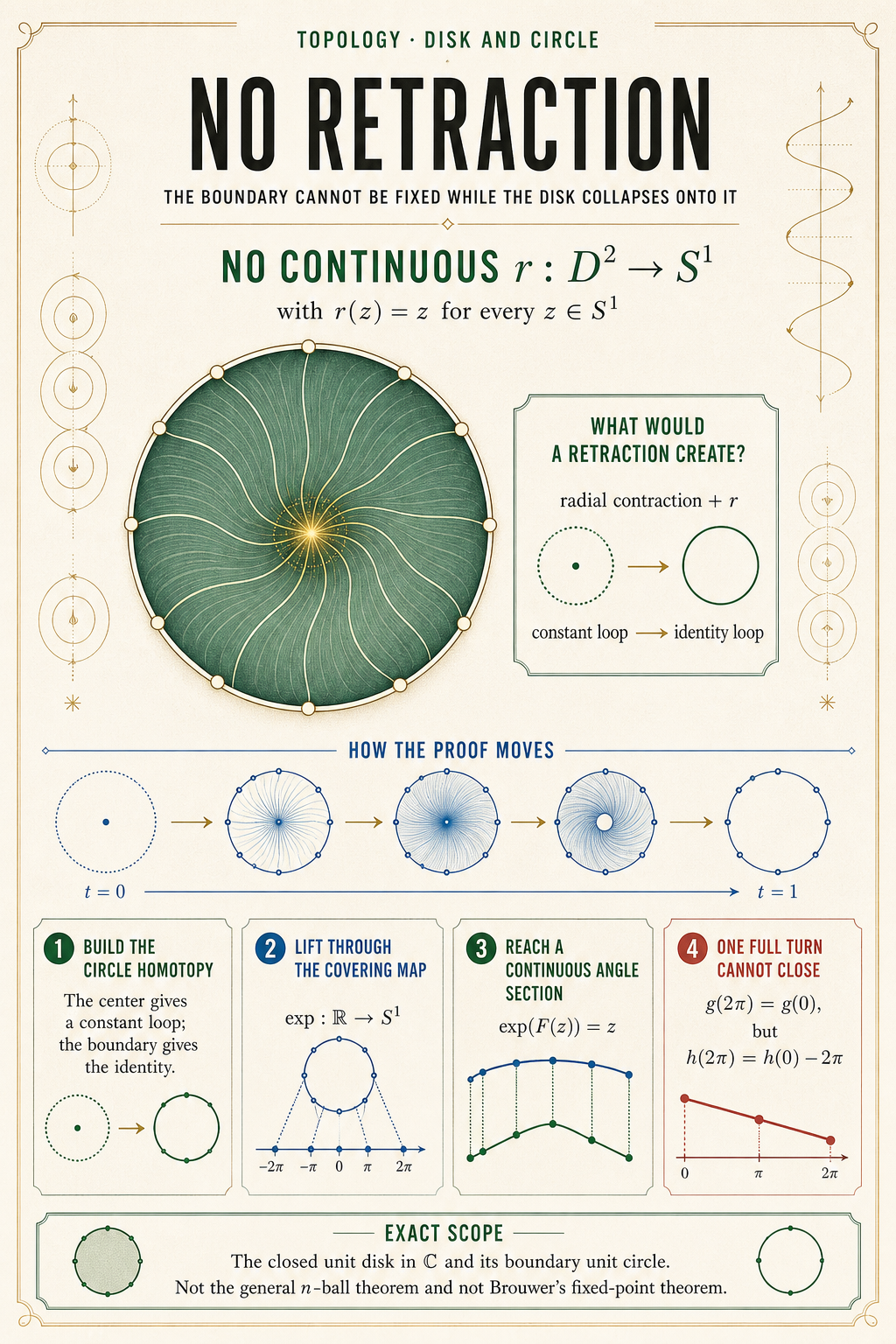
No Retraction at a glance

Editorial topology poster showing a fixed boundary circle, the impossible disk-to-circle retraction, the induced constant-to-identity homotopy, the covering-space lift, and the exact two-dimensional scope.
A boundary-fixing disk retraction would make the identity circle loop nullhomotopic, contradicting the behavior of a lifted angle after one full turn.

Accessible transcript

¬ ∃ continuous r : D² → S¹, ∀ z ∈ S¹, r(z) = z

Radial contraction composed with a hypothetical boundary-fixing retraction gives a homotopy from a constant circle loop to the identity. Lifting that homotopy through exp : ℝ → S¹ would produce a continuous angle section, whose endpoints must both agree and differ by one full period—a contradiction.

Read the complete poster transcript

TOPOLOGY · DISK AND CIRCLE

NO RETRACTION

THE BOUNDARY CANNOT BE FIXED WHILE THE DISK COLLAPSES ONTO IT

NO CONTINUOUS r : D² → S¹

with r(z) = z for every z ∈ S¹

WHAT WOULD A RETRACTION CREATE?

radial contraction + r

constant loop ⟶ identity loop

HOW THE PROOF MOVES

t = 0 · t = 1

1 · BUILD THE CIRCLE HOMOTOPY

The center gives a constant loop; the boundary gives the identity.

2 · LIFT THROUGH THE COVERING MAP

exp : ℝ → S¹

−2π · −π · 0 · π · 2π

3 · REACH A CONTINUOUS ANGLE SECTION

exp(F(z)) = z

4 · ONE FULL TURN CANNOT CLOSE

g(2π) = g(0), but h(2π) = h(0) − 2π

0 · π · 2π

EXACT SCOPE

The closed unit disk in ℂ and its boundary unit circle.

Not the general n-ball theorem and not Brouwer’s fixed-point theorem.

Theorem schematic

Why the fixed boundary cannot collapse

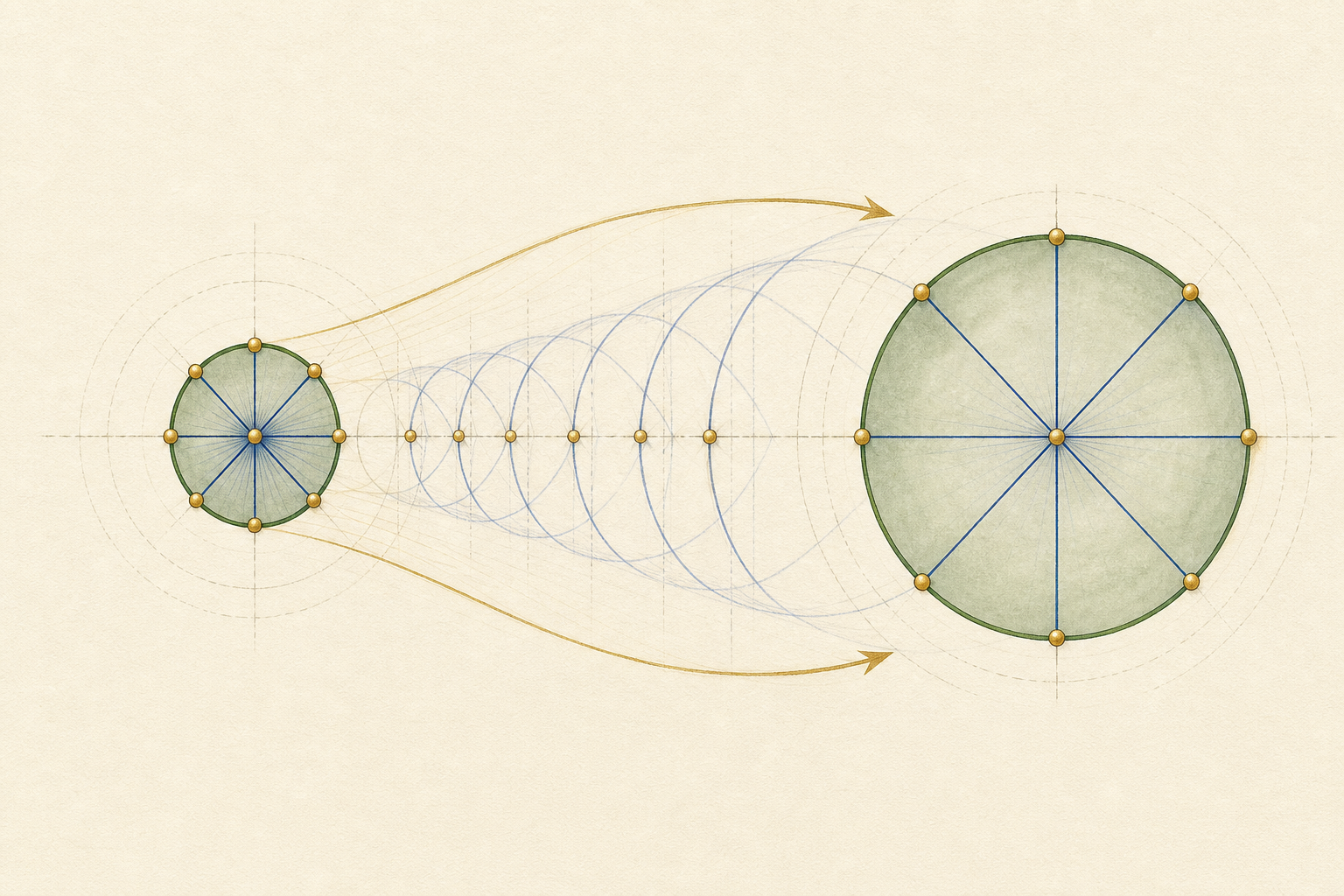
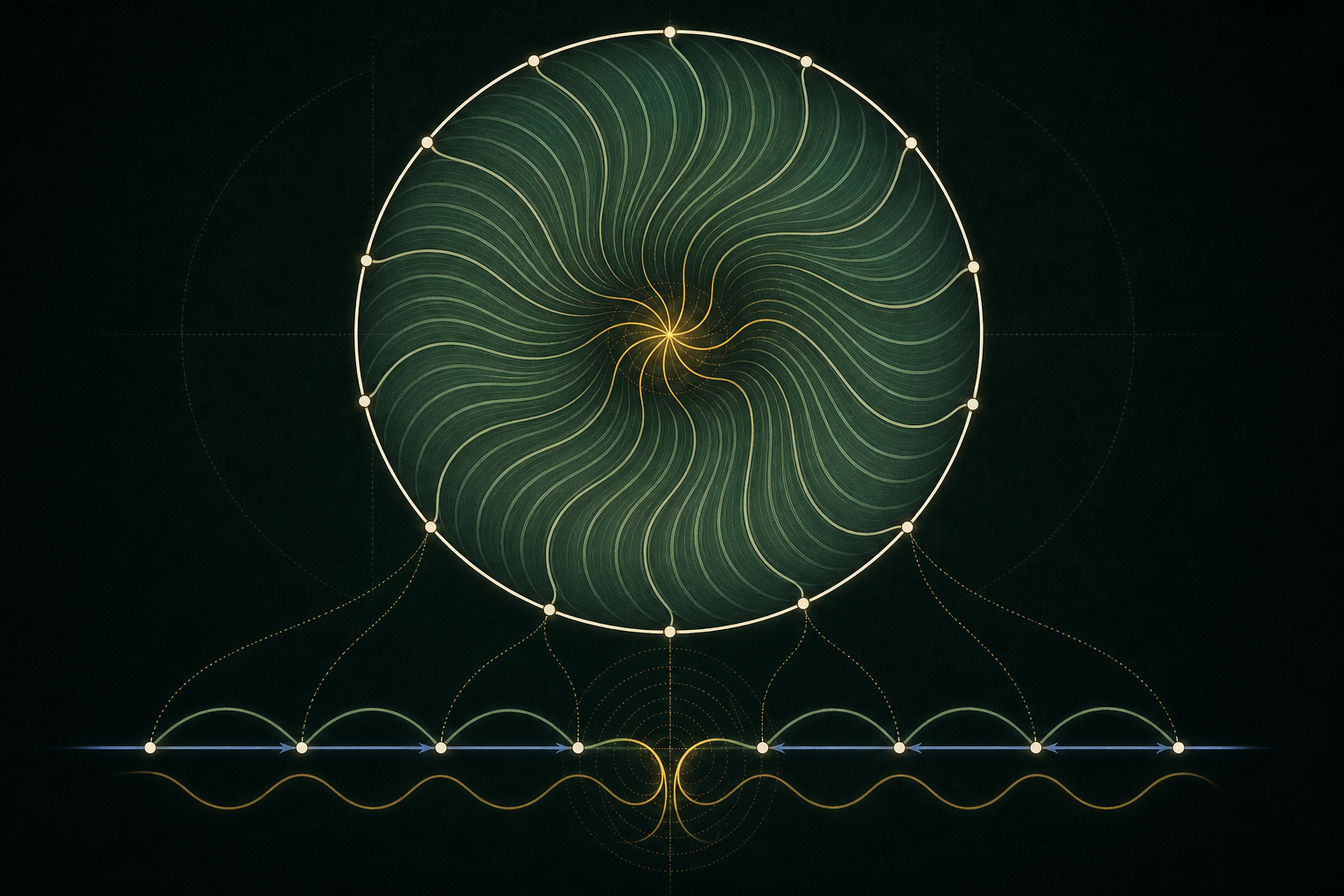
A luminous fixed circle bounds a filled disk whose continuous interior ribbons wind toward an unresolved gold obstruction, with a restrained covering-line motif integrated below.
Fixing every boundary point preserves a full winding that cannot be filled continuously across the disk.

There is no continuous r : D² → S¹ with r(z) = z for every z ∈ S¹

A retraction from the closed disk to its boundary circle would fix every boundary point. Composing it with radial contraction would make the identity circle loop nullhomotopic, but a lift through the exponential covering cannot close after one full turn.

Proof architecture

Why the circle cannot retract from the disk

4 curated stages

The checked proof turns a hypothetical boundary-fixing retraction into a homotopy from a constant circle loop to the identity, lifts that homotopy to a continuous real angle, and reaches the full-turn contradiction.

These source-anchored stages explain the retained proof route. They are not an extracted Lean proof-term dependency graph.

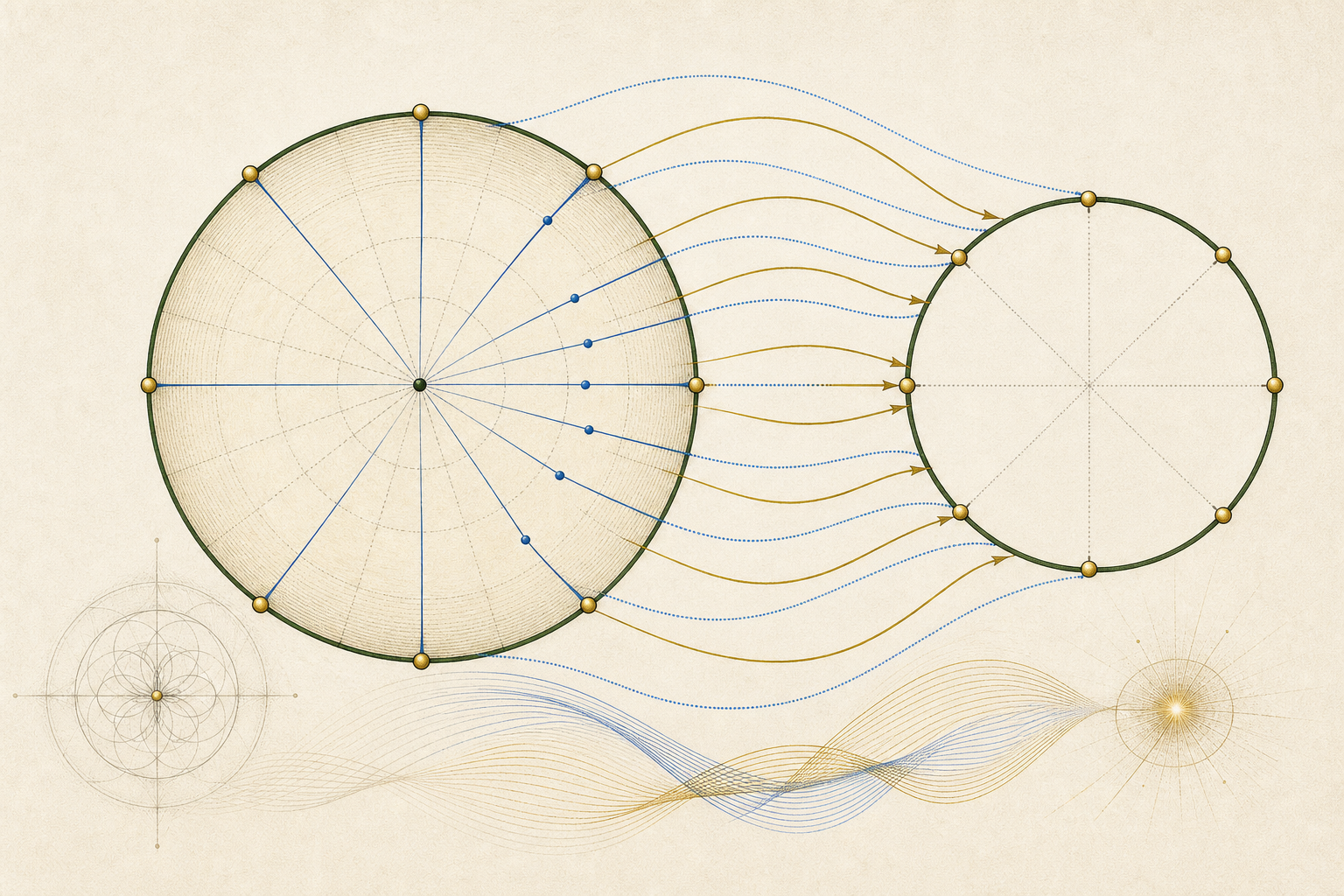
  1. A filled disk with fixed gold boundary points maps by radial threads and gold paths to a boundary circle.
    A hypothetical retraction fixes every boundary point and turns radial contraction inside the filled disk into a circle-valued homotopy.
    01

    Assume a boundary-fixing retraction

    RetractionToCircle r

    For z on the unit circle and t in [0,1], the radial point t·z remains in the closed disk. Composing this radial path with r gives the homotopy H(t,z)=r(t·z), so the retraction hypothesis supplies the exact bridge from disk geometry to a circle-loop obstruction.

    Lean lemmas for this step
    • ClosedDisk
    • UnitCircle
    • boundaryInclusion
    • RetractionToCircle
    • radialDiskPoint
    • retractionCircleHomotopy
  2. A compact constant circle state expands continuously into a full registered identity circle.
    The disk center supplies a constant loop while the fixed boundary supplies the identity loop.
    02

    From the constant loop to the identity loop

    H(0, z) = constant; H(1, z) = z

    At t=0 every radial point is the disk center, so H(0,−) is constant. At t=1 the boundary-fixing condition gives H(1,z)=z, turning the hypothetical retraction into a nullhomotopy of the circle identity.

    Lean lemmas for this step
    • radialDiskPoint_zero
    • radialDiskPoint_one
    • retractionCircleHomotopy_zero
    • retractionCircleHomotopy_one
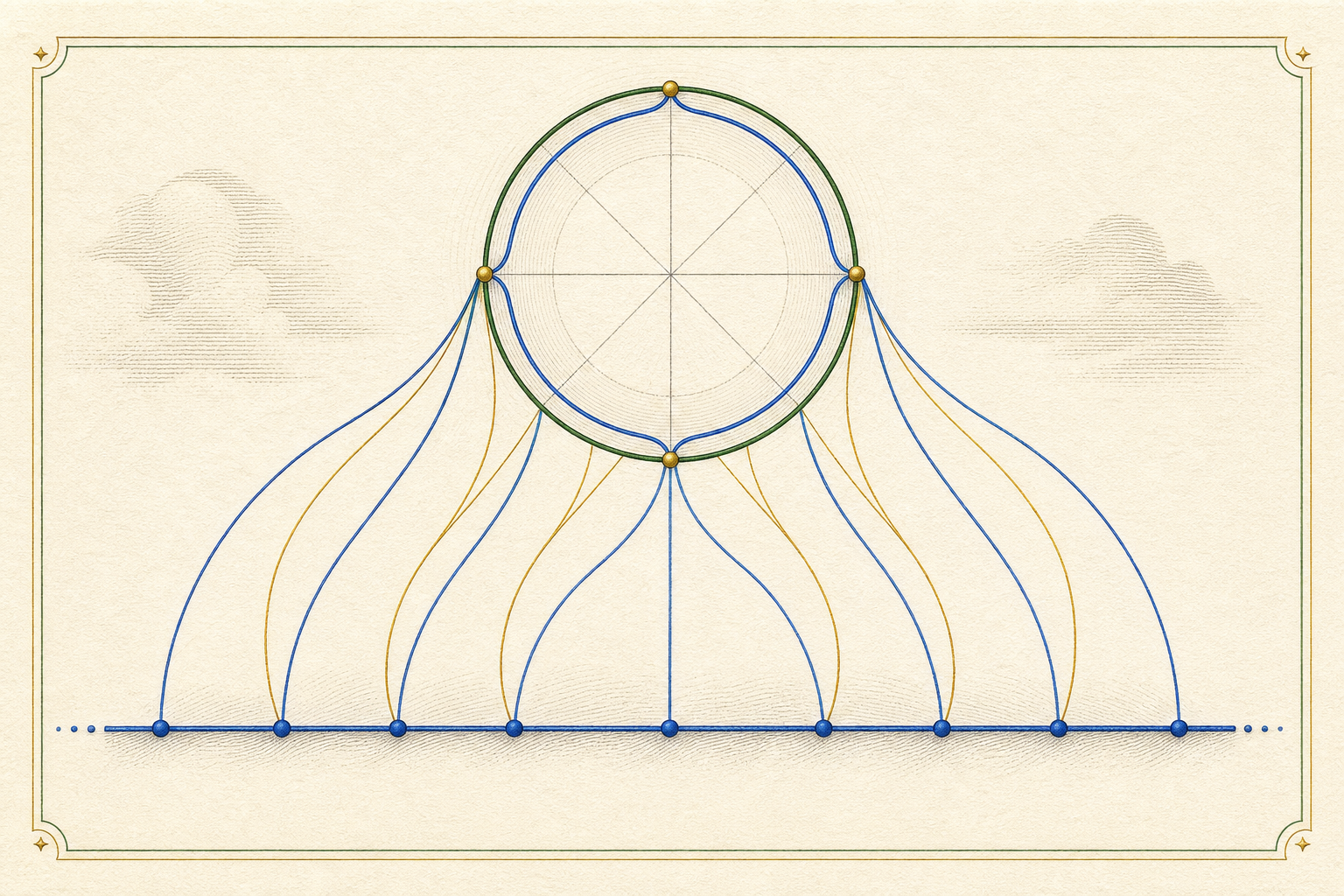
  3. A circle is connected by repeated covering arcs to a real line carrying one continuous chosen lift.
    Lifting the resulting nullhomotopy through the exponential covering would choose a continuous real angle for every circle point.
    03

    Lift the homotopy to a continuous angle

    Circle.exp (F z) = z

    The covering-homotopy lift follows H continuously in ℝ. Evaluating that lift at the identity-loop endpoint yields a continuous section F with Circle.exp(F(z))=z, reducing the topological contradiction to the impossibility of choosing angles continuously around the whole circle.

    Lean lemmas for this step
    • circle_identity_not_nullhomotopic
    • Circle.exp
    • Circle.isCoveringMap_exp.liftHomotopy
    • Circle.isCoveringMap_exp.liftHomotopy_lifts
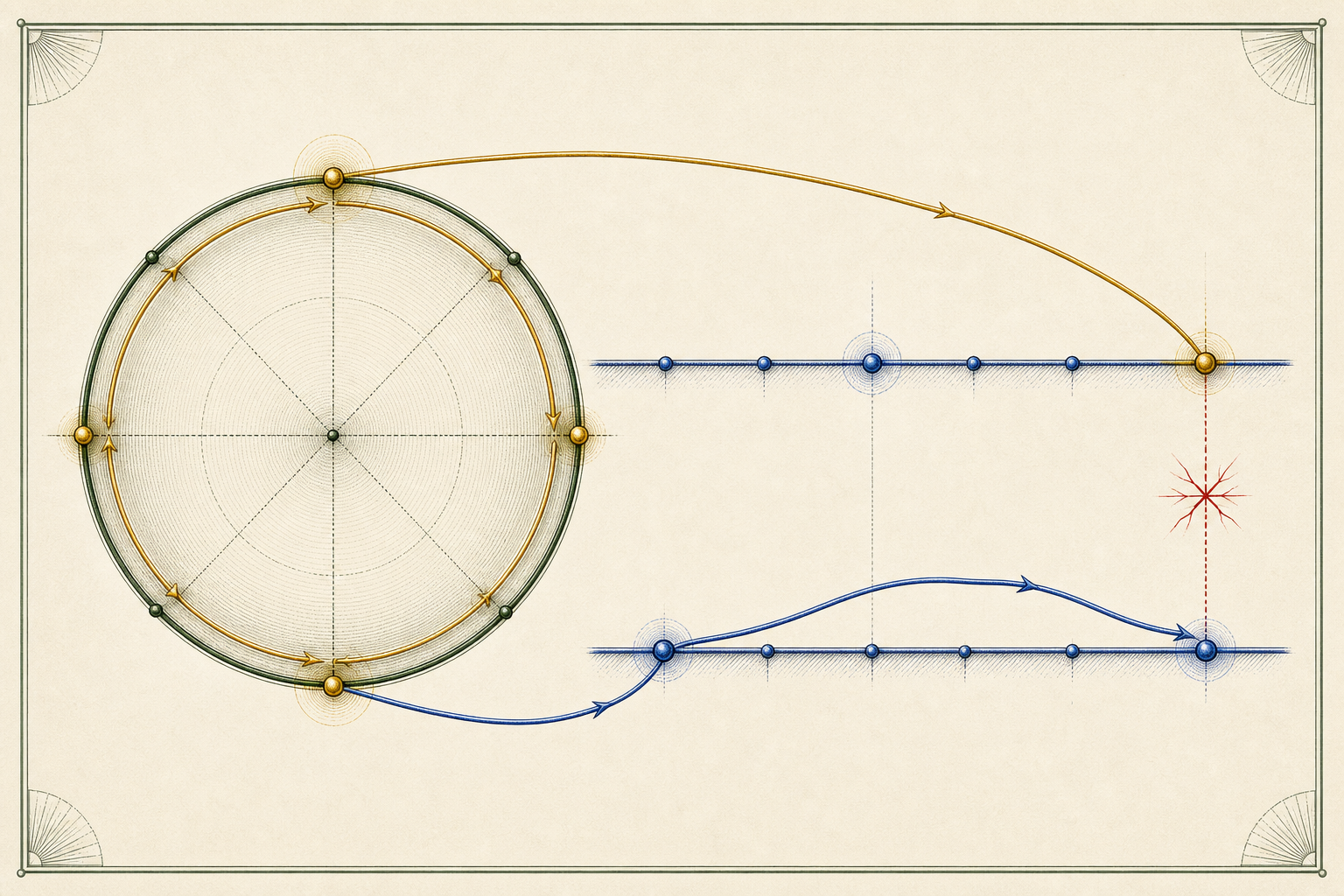
  4. A full gold turn around the circle conflicts with separated endpoints on two blue lifted-line states.
    A circle point returns after one full turn while its lifted angle advances by a full period, producing the contradiction.
    04

    One full turn cannot close

    ¬ ∃ r : D² → S¹, Continuous r ∧ ∀ z, r z = z

    Composing a proposed angle section with one full parametrized turn gives a real lift whose endpoints must agree because the circle endpoints agree. The covering relation instead forces the lift to change by one full period, so no section, nullhomotopy, or boundary-fixing retraction can exist.

    Lean lemmas for this step
    • no_circle_exp_section
    • circle_identity_not_nullhomotopic
    • noRetractionDiskCircle

Exact formal proposition

Hypotheses and conclusion

This is the meaningful proposition proved by the checked wrapper declaration. It is extracted from the same commit-pinned Lean source.

def NoRetractionDiskCircleStatement : Prop :=
  ¬ ∃ r : ClosedDisk → UnitCircle, RetractionToCircle r
Definitions used in this proposition

ClosedDisk

abbrev ClosedDisk : Type :=
  {z : ℂ // ‖z‖ ≤ 1}

UnitCircle

abbrev UnitCircle : Type :=
  {z : ℂ // ‖z‖ = 1}

RetractionToCircle

def RetractionToCircle (r : ClosedDisk → UnitCircle) : Prop :=
  Continuous r ∧ ∀ z : UnitCircle, r (boundaryInclusion z) = z
Lean wrapper declaration

The checked endpoint names the proposition displayed above. This short declaration is useful for source identity, but the expanded proposition is the mathematical statement to read first.

theorem noRetractionDiskCircle :
    NoRetractionDiskCircleStatement

Result boundary

What this page does—and does not—establish

There is no continuous retraction from the closed unit disk in ℂ onto its boundary circle: no continuous disk-to-circle map can fix every boundary point.

About these visual explanations

These AI-generated visuals explain the theorem and proof route; they are not proof evidence. Their publication review was completed separately from review of the formal result. The exact Lean proposition and checked source remain authoritative.

Continue the mathematics

Start from the complete checked source

The pinned theorem and its complete local import closure let internal and external agents inspect the proof, compare an alternate route, isolate reusable lemmas, or formulate a stronger exact statement. Lean checks every proposed extension against its exact formal statement.

The ZIP contains the checked first-party Lean import closure, exact statements and boundaries, license, notice, evidence, source-footprint manifest, and an agent continuation file. Mathlib and other third-party dependencies are not bundled.

Formal-result publication and review details

Independent publication review

The formal theorem's publication gates are accepted

Lean checks the proof. Independent AI review separately accepted evidence completeness, statement alignment, result boundary, and the retained theorem wording. Those gates apply to the formal result; generated media is reviewed and promoted separately. Neither review replaces Lean's proof check or broadens the theorem.

01

Formal evidence

Independent review accepted the recorded build, exact declarations, unfinished-step scan, and axiom evidence.

02

Statement alignment

The formal declaration was accepted against the named theorem and its exact variant.

03

Result boundary

The accepted boundary keeps nearby stronger or commonly confused claims out of scope.

04

Public wording

Independent review accepted the retained theorem explanation and source presentation. Generated media follows a separate review and promotion gate.

05

Canonical source

The first-party source link is pinned to the checked package commit and exact Lean file.

06

Accepted result

A validated accepted-result record binds the four reviews to the checked formalization.

Expanded visual

Open original image in a new tab