Formal evidence
Independent review accepted the recorded build, exact declarations, unfinished-step scan, and axiom evidence.
Geometry · formal theorem
Given three complex points and ω² − ω + 1 = 0, the centroids of consistently oriented equilateral constructions on their sides form an equilateral triple.
Line counts exclude blank lines; comments and documentation count. The total is the commit-pinned first-party Lean import closure; Mathlib and other third-party dependencies are excluded.
The theorem at a glance
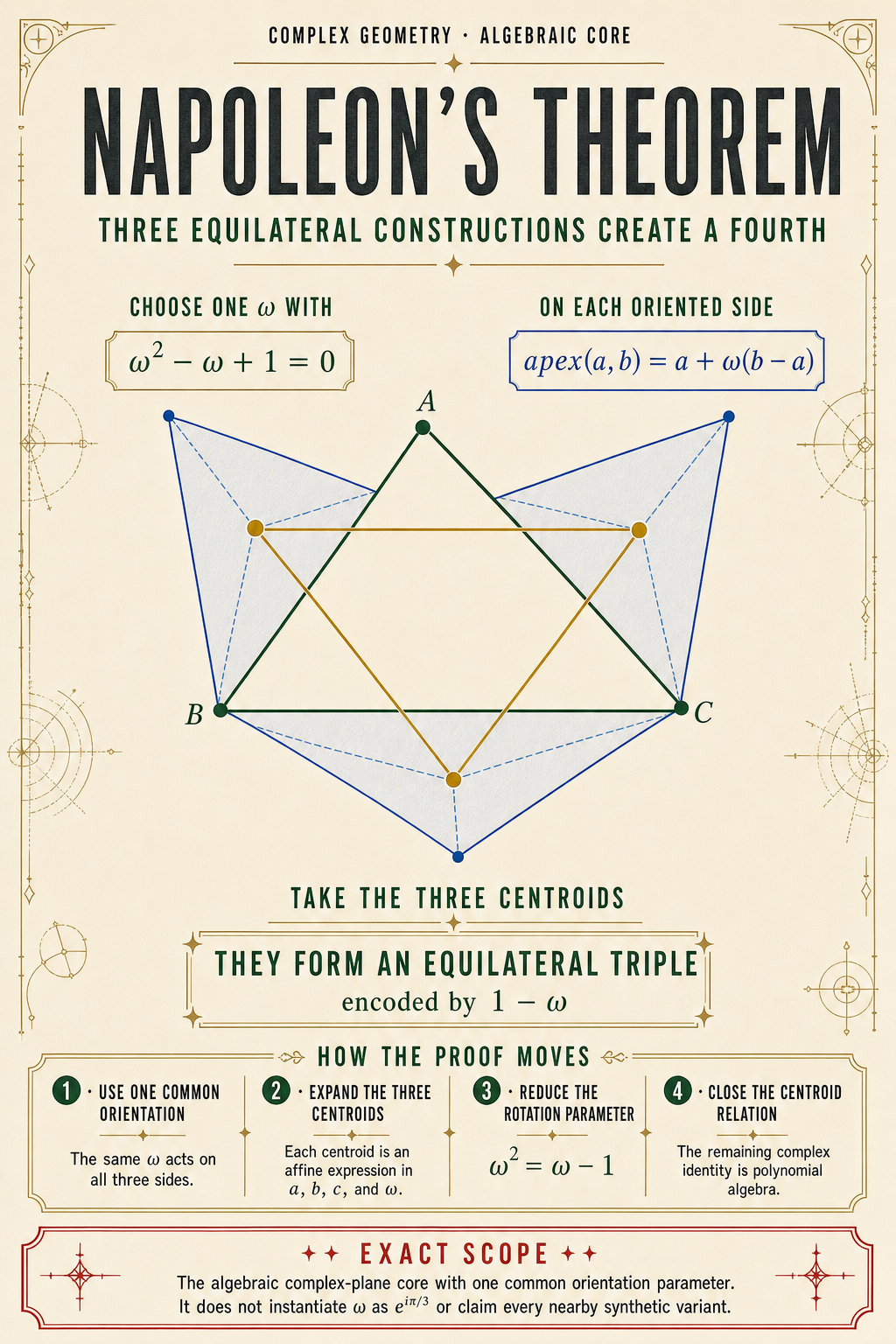
Accessible transcript
ω² − ω + 1 = 0 and apex(a,b)=a+ω(b−a) ⇒ the three centroids form an equilateral triple
The same root ω of ω² − ω + 1 defines all three oriented side constructions. Expanding their centroids as affine expressions and reducing powers of ω proves that the three centroids form an equilateral triple. This is the common-orientation algebraic core, not every synthetic variant.
COMPLEX GEOMETRY · ALGEBRAIC CORE
NAPOLEON’S THEOREM
THREE EQUILATERAL CONSTRUCTIONS CREATE A FOURTH
CHOOSE ONE ω WITH
ω² − ω + 1 = 0
ON EACH ORIENTED SIDE
apex(a,b) = a + ω(b − a)
A · B · C
TAKE THE THREE CENTROIDS
THEY FORM AN EQUILATERAL TRIPLE
encoded by 1 − ω
HOW THE PROOF MOVES
1 · USE ONE COMMON ORIENTATION
The same ω acts on all three sides.
2 · EXPAND THE THREE CENTROIDS
Each centroid is an affine expression in a, b, c, and ω.
3 · REDUCE THE ROTATION PARAMETER
ω² = ω − 1
4 · CLOSE THE CENTROID RELATION
The remaining complex identity is polynomial algebra.
EXACT SCOPE
The algebraic complex-plane core with one common orientation parameter.
It does not instantiate ω as eⁱπ⁄³ or claim every nearby synthetic variant.
Theorem schematic

ω² − ω + 1 = 0 ⇒ the three constructed centroids satisfy an equilateral relation
Choose one common parameter ω satisfying ω² − ω + 1 = 0 and use it to construct an oriented equilateral apex on each side. The centroids of those three side constructions satisfy the corresponding equilateral relation.
Exact formal proposition
This is the meaningful proposition proved by the checked wrapper declaration. It is extracted from the same commit-pinned Lean source.
noncomputable def NapoleonTheoremStatement : Prop :=
  ∀ ω a b c : ℂ,
    IsSixtyDegreeRotationParameter ω →
      let ab := orientedEquilateralApex ω a b
      let bc := orientedEquilateralApex ω b c
      let ca := orientedEquilateralApex ω c a
      let cab := centroid a b ab
      let cbc := centroid b c bc
      let cca := centroid c a ca
IsEquilateralBy (1 - ω) cab cbc ccaIsSixtyDegreeRotationParameter def IsSixtyDegreeRotationParameter (ω : ℂ) : Prop :=
ω ^ 2 - ω + 1 = 0orientedEquilateralApex def orientedEquilateralApex (ω a b : ℂ) : ℂ :=
a + ω * (b - a)centroidnoncomputable def centroid (a b c : ℂ) : ℂ :=
(a + b + c) / 3IsEquilateralBy def IsEquilateralBy (ω x y z : ℂ) : Prop :=
z - x = ω * (y - x)The checked endpoint names the proposition displayed above. This short declaration is useful for source identity, but the expanded proposition is the mathematical statement to read first.
theorem napoleonTheorem : NapoleonTheoremStatementResult boundary
Given three complex points and a number ω satisfying ω² − ω + 1 = 0, the centroids of consistently oriented equilateral constructions on their sides form an equilateral triple.
These AI-generated visuals explain the theorem and proof route; they are not proof evidence. Their publication review was completed separately from review of the formal result. The exact Lean proposition and checked source remain authoritative.
Continue the mathematics
The pinned theorem and its complete local import closure let internal and external agents inspect the proof, compare an alternate route, isolate reusable lemmas, or formulate a stronger exact statement. Lean checks every proposed extension against its exact formal statement.
The ZIP contains the checked first-party Lean import closure, exact statements and boundaries, license, notice, evidence, source-footprint manifest, and an agent continuation file. Mathlib and other third-party dependencies are not bundled.
Independent publication review
Lean checks the proof. Independent AI review separately accepted evidence completeness, statement alignment, result boundary, and the retained theorem wording. Those gates apply to the formal result; generated media is reviewed and promoted separately. Neither review replaces Lean's proof check or broadens the theorem.
Independent review accepted the recorded build, exact declarations, unfinished-step scan, and axiom evidence.
The formal declaration was accepted against the named theorem and its exact variant.
The accepted boundary keeps nearby stronger or commonly confused claims out of scope.
Independent review accepted the retained theorem explanation and source presentation. Generated media follows a separate review and promotion gate.
The first-party source link is pinned to the checked package commit and exact Lean file.
A validated accepted-result record binds the four reviews to the checked formalization.